Mammalia |
Cetartiodactyla |
Delphinidae
Environnement : milieu / zone climatique / profondeur / gamme de distribution
Écologie
Pélagique; profondeur 0 - 200 m, usually 1 - 10 m. Tropical; 7°S - 90°S, 100°E - 180°E
Indo-Pacific: Australia and Papua New Guinea.
Longueur à la première maturité / Taille / Poids / Âge
Maturité: Lm ? range ? - ? cm Max length : 270 cm TL mâle / non sexé; (Réf. 78832); 230 cm TL (female)
Description synthétique
Morphologie
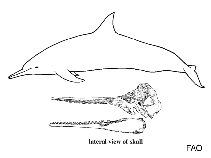
In lateral view the head is rounded and usually bounded by a distinct neck crease, lacking dorsal groove; mesethmoid plate reduced and generally in advance of the anterior most nasal ossicle, exposing a large area of the frontal bone; presence of supernumerary bone between nasal ossicles and posterior border of mesethmoid; has a greater length of the antiorbital process and a more closely opposed pterygoid hamuli with medial flanges.
Occurs in protected, shallow, coastal waters especially adjacent to river and creek mouths (Ref. 79537).
Cycle de vie et comportement reproducteur
Maturité | Reproduction | Frai | Œufs | Fécondité | Larves
Beasley, I., K.M. Robertson and P. Arnold 2005 Description of a new dolphin, the Australian snubfin dolphin Orcaella heinsohni sp. n. (Cetacea, Delphinidae). Marine Mammal Science 21(3):365-400. (Réf. 78832)
Statut dans la liste rouge de l'IUCN
(Réf. 130435: Version 2025-2 (Global))
statut CITES (Réf. 108899)
Menace pour l'homme
Harmless
Utilisations par l'homme
FAO - pêcheries: landings search; Publication: search | FishSource |
Outils
Plus d'informations
Écologie trophiqueAliments (proies)
Composition du régime alimentaire
Consommation alimentaire
Prédateurs
Dynamique des populationsCroissanceÂges / tailles maximalesLongueur-poids rel.Rel. longueur-longueur.Fréquences de longueursConversion de masseAbondance Cycle de vieReproductionMaturitéFéconditéFraiŒufsDéveloppement de l'œufLarves PhysiologieConsommation d'oxygène
Liées à l'hommeTimbres, pièces de monnaie, divers
Sources Internet
Estimations basées sur des modèles
Vulnérabilité de la pêche
(Réf. 71543) |
Very high vulnerability (90 of 100). |