Holothuroidea |
Holothuriida |
Holothuriidae
Environnement : milieu / zone climatique / profondeur / gamme de distribution
Écologie
Récifal; profondeur 36 - 200 m (Réf. 81020). Tropical
Widespread in the Indo-Pacific.
Longueur à la première maturité / Taille / Poids / Âge
Maturité: Lm ? range ? - ? cm Max length : 50.0 cm TL mâle / non sexé; (Réf. 85218); common length : 32.0 cm TL mâle / non sexé; (Réf. 122); poids max. publié: 1.6 kg (Réf. 122)
Description synthétique
Morphologie
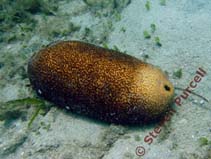
Mean live weight 1,200 to 1,600 g; body-wall thickness: 0.7 cm. Body cylindrical, arched dorsally (bivium) and flattened ventrally (trivium); calcareous disc of podia around 300 micrometer in diameter. Mouth ventral, surrounded by 20 small, short and yellowish tentacles. Anus nearly dorsal. Calcareous ring with large radial pieces and narrow interradials. Cuvierian tubules numerous and thick. Bivium yellow with brown band; trivium lighter; podia on bivium and trivium encircled by a characteristics brown spot. Spicules on ventral tegument with a variety of pseudo-rosettes and biscuit-like nodules; dorsal tegument with rosettes and a few rods; ventral podia with various rods; tentacles with rods, straight or slightly curved and very spiny.
May be harvested with other reef flat species, such as Bohadschia similis and Holothuria scabra, when they occur together, but the sticky Cuvierian tubules make the collection and processing disagreeable. Collected by hand at low tide, or by divers. Processed product is not distinguished from those of other Bohadschia species and is of little commercial value. Found in moderately shallow waters; mostly on coastal lagoons and inner reef flats; abundant in sandy-muddy sediments where it burrows most of the time (Ref. 122). Known to be nocturnally active (Ref. 85218). Population densities generally less than 0.02 per square meter (Ref. 122).
Cycle de vie et comportement reproducteur
Maturité | Reproduction | Frai | Œufs | Fécondité | Larves
Conand, C. 1998 Holothurians (sea cucumbers, Class Holothuroidea). p. 1157-1190. In Carpenter, K.E. and V.H. Niem (eds.) FAO Species Identification Guide for Fishery Purposes. The Living Marine Resources of the Western Central Pacific. Vol. 2. Cephalopods, crustaceans, holothurians and sharks. FAO Rome. (Réf. 122)
Statut dans la liste rouge de l'IUCN
(Réf. 130435: Version 2025-2 (Global))
statut CITES (Réf. 108899)
Not Evaluated
Not Evaluated
Menace pour l'homme
Harmless
Utilisations par l'homme
Pêcheries: intérêt commercial mineur
FAO - Publication: search | FishSource | Sea Around Us
Outils
Plus d'informations
Écologie trophiqueAliments (proies)
Composition du régime alimentaire
Consommation alimentaire
Prédateurs
Dynamique des populations Cycle de vieReproductionMaturitéFéconditéFraiŒufsDéveloppement de l'œufLarves PhysiologieConsommation d'oxygène
Liées à l'hommeTimbres, pièces de monnaie, divers
Sources Internet
Estimations basées sur des modèles
Vulnérabilité de la pêche
(Réf. 71543) |
Moderate vulnerability (40 of 100). |
Catégorie de prix
(Réf. 80766): |
Unknown. |