Malacostraca |
Decapoda |
Calappidae
Miljö: miljö / Klimatzon / djupintervall / distributionsområde
Ekologi
Benthic; djupintervall 10 - 40 m (Ref. 343). Tropical
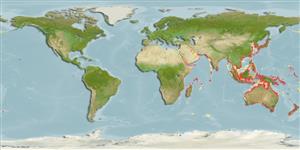
Indo-West Pacific and Atlantic Ocean: Southeast Asia to Australia and westward to India.
Längd vid första mognad / Storlek / Vikt / Ålder
Könsmognad: Lm 3.2 range ? - ? cm Max length : 11.5 cm CW hane/ej könsbestämd; (Ref. 119018); 5.3 cm CW (female); publicerad maxvikt: 30.90 g (Ref. 119018); publicerad maxvikt: 30.90 g
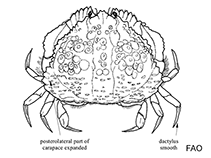
Carapace rounded, with 2 long, well-developed lateral spines; anterolateral margins unevenly serrated. Outer surface of palm with strong oblique ridge. Mosaic to reticulate network of maroon lines on a white background.
Intertidal (Ref. 106854) to subtidal, on substrates ranging from sandy, muddy to shelly (Ref. 125642). Matutinae are facultative scavengers and opportunistic predators of benthic invertebrates, feeding mainly on mollusks and small crustaceans (Ref. 108791).
Livscykel och parningsbeteende
Könsmognad | Reproduktion | Lek | Ägg | Fekunditet | Larver
Members of the order Decapoda are mostly gonochoric. Mating behavior: Precopulatory courtship ritual is common (through olfactory and tactile cues); usually indirect sperm transfer.
Ng, P.K.L. 1998 Crabs. p. 1045-1155. In K.E. Carpenter and V.H. Niem (eds) FAO species identification guide for fishery purposes. The living marine resources of the Western Central Pacific. Volume 2. Cephalopods, crustaceans, holothurians and sharks. Rome, FAO. 1998. pp. 687-1396. (Ref. 343)
Status på IUCN:s rödlista
(Ref. 130435: Version 2025-2 (Global))
CITES-status (Ref. 108899)
Not Evaluated
Not Evaluated
Hot mot människor
Harmless
Mänskliga användningsområden
Fiskeri: kommersiell
FAO - Publication: search | FishSource |
Verktyg
Ytterligare information
Trofisk ekologiLivsmedelsartiklar (preys)
Födosammansättning
Födointag
Predatorer
MänniskorelateradFrimärken, mynt, diverse.
Internet-källor
Uppskattningar baserade på modeller
Sårbarhet i fisket
(Ref. 71543) |
Low vulnerability (10 of 100). |
Priskategori
(Ref. 80766): |
Unknown. |