Malacostraca |
Decapoda |
Calappidae
पर्यावरण: पर्यावरण / जलवायु क्षेत्र / गहराई सीमा / वितरण सीमा
पारिस्थितिकी
Benthic; गहराई सीमा 0 - 20 m (संदर्भ 343). Tropical
Indo-Pacific: Southeast Asia to Fiji and New Hebrides.
प्रथम परिपक्वता पर लंबाई / आकार / वज़न / आयु
परिपक्व अवधि: Lm ?, range 3 - 4.46 cm Max length : 5.0 cm CW पुल्लिंग / अलिंग; (संदर्भ 343)
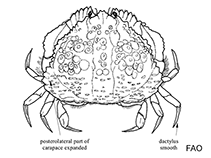
Carapace rounded, with 2 long, well-developed lateral spines; anterolateral margins gently serrated. Outer surface of palm with low but distinct oblique ridge. Color: yellowish ground color with numerous fine black spots and several larger ones on carapace; legs and chelae bright yellow.
Caught by local communities in nets, by hand or beach seines. On sandy areas (Ref. 343), and intertidal mudflats (Refs. 128960, 9773). Carnivorous and facultative scavengers. Preys mainly on crustaceans and mollusks; smaller individuals on small, soft-shelled species while larger individuals eat slow-moving invertebrates like anomurans, bivalves and gastropods (Ref. 102715). Scavenger-predator (Ref. 128960). Usually seen swimming along the tidal current. Known to burrow in sand (Ref. 9773).
Members of the order Decapoda are mostly gonochoric. Mating behavior: Precopulatory courtship ritual is common (through olfactory and tactile cues); usually indirect sperm transfer.
Ng, P.K.L. 1998 Crabs. p. 1045-1155. In K.E. Carpenter and V.H. Niem (eds) FAO species identification guide for fishery purposes. The living marine resources of the Western Central Pacific. Volume 2. Cephalopods, crustaceans, holothurians and sharks. Rome, FAO. 1998. pp. 687-1396. (संदर्भ 343)
आईयूसीएन रेड लिस्ट स्थिति
(संदर्भ 130435: Version 2025-2 (Global))
CITES स्थिति (संदर्भ 108899)
Not Evaluated
CMS (संदर्भ 116361)
Not Evaluated
मनुष्यों के लिए ख़तरा
Harmless
मानव उपयोग
मात्स्यिकी: निर्वाह मात्स्यिकी
FAO - Publication: search | FishSource |
साधन
अधिक जानकारी
जनसंख्या गतिशीलताबाढ़अधिकतम आयु/आकारलंबाई-वजन संबंधलंबाई-लंबाई संबंधलंबाई-आवृत्तियाँसामूहिक रूपांतरणबहुतायत फिजियोलॉजीप्राणवायु की खपत
मानव संबंधीटिकट, सिक्के, विविध.
इंटरनेट स्रोत
मॉडल पर आधारित अनुमान
मछली पकड़ने की भेद्यता
(संदर्भ 71543) |
Low vulnerability (10 of 100). |
मूल्य श्रेणी
(संदर्भ 80766): |
Unknown. |