Gastropoda |
Neogastropoda |
Melongenidae
Umwelt: Milieu / Klimazone / Tiefenbereich / Verbreitungsgebiet
Ökologie
Benthic; tiefenbereich 0 - 30 m (Ref. 83435). Tropical; 12°N - 28°S, 62°E - 0°E (Ref. 83435)
Atlantic Ocean: Trinidad and Tobago to Brazil, and tropical West Africa.
Länge bei der ersten Reifung / Größe / Gewicht / Alter
Geschlechtsreife: Lm ? range ? - ? cm Max length : 16.6 cm DL Männchen/unbestimmt; (Ref. 83435); common length : 16.0 cm TL Männchen/unbestimmt; (Ref. 355)
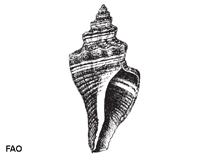
Shell fusiform, spire high, anterior canal well developed, shell surface with sculpture of many fine spiral threads. Shoulder angular, with single row or nodules. Periostracum thick and hairy. Colour: chocolate brown to black, with a few contrasting white bands, periostracum brownish.
Lives on mud and other soft substrates in mangrove areas and near river estuaries. Feeds mainly on carrion (Ref. 355).
Lebenszyklus und Paarungsverhalten
Geschlechtsreife | Fortpflanzung | Ablaichen | Eier | Fruchtbarkeit | Larven
This species is a non-broadcast spawner. Life cycle does not include trocophore stage. Also Ref. 833.
Leal, J.H. 2003 Gastropods. p. 99-147. In Carpenter, K.E. (ed.). The living marine resources of the Western Central Atlantic. Volume 1: Introduction, molluscs, crustaceans, hagfishes, sharks, batoid fishes, and chimaeras. FAO Species Identification Guide for Fishery Purposes and American Society of Ichthyologists and Herpetologists Special Publication No. 5. 1600p. (Ref. 355)
IUCN Rote Liste Status
(Ref. 130435: Version 2025-2 (Global))
CITES Status (Ref. 108899)
Not Evaluated
Not Evaluated
Bedrohung für Menschen
Harmless
Nutzung durch Menschen
FAO - Publication: search | FishSource |
Tools
Mehr Information
Trophische ÖkologieLebensmittel (Beutetiere)
Nahrungszusammensetzung
Nahrungsaufnahme
Räuber
PopulationsdynamikWachstum
Max. Alter/Größen
Länge-Gewicht-Rel.
Länge-Länge-Verhältnis.
Längenhäufigkeiten
Massenkonvertierung
Dichte
LebenszyklusFortpflanzungGeschlechtsreifeFruchtbarkeitAblaichenEierEientwicklungLarven PhysiologieSauerstoffverbrauch
MenschenbezogenBriefmarken, Münzen, Verschiedenes.
Internet Quellen
Schätzungen auf der Grundlage von Modellen
Anfälligkeit der Fischerei
(Ref. 71543) |
Low vulnerability (10 of 100). |
Preiskategorie
(Ref. 80766): |
Unknown. |