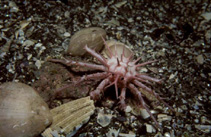
Malacostraca |
Decapoda |
Lithodidae | Lithodinae
Milieu: milieu / Klimaatzone / Diepte / verspreidingsgebied
Ecologie
Benthic; diepte 16 - 1030 m (Ref. 93860). Deep-water, preferred 5°C (Ref. 107945); 15°S - 65°S, 180°W - 180°E
Indo-Pacific, Atlantic and Antarctic. Tropical to polar.
Lengte bij maturiteit / Grootte / Gewicht / Leeftijd
Maturiteit: Lm ? range ? - ? cm Max length : 10.7 cm TL mannelijk / geslacht onbekend; (Ref. 89171)
Benthic. Occurs in deep water (Ref. 93860). Found on rocky bottoms (Ref. 103032) as well as soft bottoms with sparse epifauna (Ref. 106495). Has a very diverse diet and is an opportunistic forager and scavenger (Ref. 93860). Feeds on benthic sessile and slow-moving organisms (Ref. 96496). Highly opportunistic and also displays necrophagy (Ref. 113076).
Levenscyclus en paargedrag
Maturiteit | Voortplanting | Paaien | Eieren | Fecunditeit | Larven
Members of the order Decapoda are mostly gonochoric. Mating behavior: Precopulatory courtship ritual is common (through olfactory and tactile cues); usually indirect sperm transfer.
Davie, P.J.F. 2002 Crustacea: Malacostraca: Eucarida (Part 2): Decapoda - Anomura, Brachyura. In A. Wells and W.W.K. Houston (eds.) Zoological Catalogue of Australia. Vol. 19.3B. Melbourne: CSIRO Publishing, Australia xiv 641 p. (Ref. 8423)
Status op de Rode Lijst van het IUCN
(Ref. 130435: Version 2025-2 (Global))
CITES status (Ref. 108899)
Not Evaluated
Not Evaluated
Gevaar voor de mens
Gebruik door de mens
Visserij: commercieel
FAO - visserij: landings search; Publication: search | FishSource | Sea Around Us
Tools
Meer informatie
LevenscyclusVoortplantingMaturiteitFecunditeitPaaienEierenOntwikkeling van de eierenLarven FysiologieZuurstofverbruik
Menselijk gerelateerdPostzegels, munten, diversen.
Internetbronnen
Schattingen op basis van modellen
Kwetsbaarheid van de visserij
(Ref. 71543) |
Low vulnerability (10 of 100). |
Kwetsbaarheid voor het klimaat
(Ref. 125649) |
Moderate vulnerability (43 of 100) |
Prijsklasse
(Ref. 80766): |
Unknown. |
Nutrients
|
Calcium = 109 [35, 184] mg/100g; Iron = 1.59 [1.21, 1.97] mg/100g; Protein = 20.2 [19.2, 21.3] %; Omega3 = 0.285 [0.185, 0.386] g/100g; Selenium = 48.3 [-31.7, 128.3] μg/100g; VitaminA = 0 μg/100g; Zinc = 1.79 [1.17, 2.40] mg/100g (wet weight); based on nutrient studies. |