Malacostraca |
Decapoda |
Portunidae
Entorno: milieu / zona climática / rango de profundidad / gama de distribución
Ecología
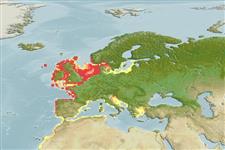
Benthic; rango de profundidad 0 - 80 m (Referencia 356), usually ? - 40 m (Referencia 435). Temperate; 4°C - 28°C (Referencia 112013), preferred 9°C (Referencia 107945); 61°N - 24°N, 16°W - 28°E
Atlantic and the Mediterranean Sea: From western Norway to the UK to Western Sahara and the Mediterranean coasts of Spain, France and Italy. Subtropical to temperate.
Longitud en la primera madurez / Tamaño / Peso / Edad
Madurez: Lm 4.8, range 4 - 5.95 cm Max length : 10.9 cm CL macho / no sexado; (Referencia 96051); 9.84 cm CL (female); common length : 4.5 cm CL macho / no sexado; (Referencia 435); edad máxima reportada: 8 años (Referencia 96051)
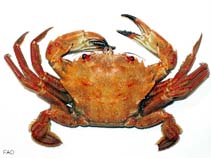
Maximum depth range from Ref. 101396. Maximum carapace width: 8.4; common carapace width: 5.5 cm (Ref. 435). Common in shallow waters from the intertidal to 80 m (Ref. 83653), common at depths not deeper than 40 m (Ref. 435). Found mostly in rocky shores, confined to the lower tidal mark (Refs. 101396). Inhabits on sand or mud (Ref. 435). Carnivore; trophic level 2.6 (Ref. 96418), trophic level 2.98 (Ref. 435). An opportunistic feeder, mostly preys on molluscs and crustaceans and also feeds on detrital material and large quantities of brown algae (Ref. 96482).
Members of the order Decapoda are mostly gonochoric. Mating behavior: Precopulatory courtship ritual is common (through olfactory and tactile cues); usually indirect sperm transfer.
SAUP Database 2006 SAUP Database. www.seaaroundus.org. (Referencia 356)
Situación en la Lista Roja de la UICN
(Referencia 130435: Version 2025-2 (Global))
Estatus CITES (Referencia 108899)
Not Evaluated
CMS (Referencia 116361)
Not Evaluated
Amenaza para el ser humano
Usos humanos
Pesquerías: comercial
FAO - pesquerías: landings search; Publication: search | FishSource | Sea Around Us
Herramientas
Más información
FisiologíaConsumo del oxígeno
Relacionados con el ser humanoSellos, monedas, varios
Fuentes de Internet
Estimaciones basadas en modelos
Vulnerabilidad pesquera
(Referencia 71543) |
Low to moderate vulnerability (33 of 100). |
Vulnerabilidad climática
(Referencia 125649) |
High vulnerability (56 of 100) |
Categoría de precios
(Referencia 80766): |
Very high. |
Nutrients
|
Calcium = 109 [35, 184] mg/100g; Iron = 1.59 [1.21, 1.97] mg/100g; Protein = 20.2 [19.2, 21.3] %; Omega3 = 0.285 [0.185, 0.386] g/100g; Selenium = 48.3 [-31.7, 128.3] μg/100g; VitaminA = 0 μg/100g; Zinc = 1.79 [1.17, 2.40] mg/100g (wet weight); based on nutrient studies. |