Bivalvia |
Ostreida |
Ostreidae
Environnement : milieu / zone climatique / profondeur / gamme de distribution
Écologie
Benthic; profondeur 0 - 550 m (Réf. 106914). Subtropical, preferred 24°C (Réf. 107945); 34°S - 47°S, 166°E - 72°W (Réf. 111844)
South Pacific Ocean: New Zealand and Chile. Introduced in the Atlantic: Wales, UK and France. Subtropical to temperate.
Longueur à la première maturité / Taille / Poids / Âge
Maturité: Lm ?, range 5 - ? cm Max length : 10.0 cm ShL mâle / non sexé; (Réf. )
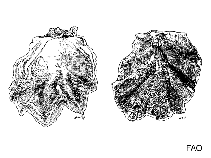
Minimum depth range from Ref. 356. Found in nearshore waters and in shallow subtidal zone (Ref. 106914). This is an epifaunal species found on soft sandy and muddy bottoms, as well as hard substrates. It is a brooding species where females retain the larvae until they are completely developed (Ref. 87801).
Cycle de vie et comportement reproducteur
Maturité | Reproduction | Frai | Œufs | Fécondité | Larves
Life cycle: Embryos develop into free-swimming trocophore larvae, succeeded by the bivalve veliger, resembling a miniature clam.
Häussermann, V. and G. Försterra 2009 Marine benthic fauna of Chilean Patagonia. Santiago, Nature in Focus. 1000 p. (Réf. 87801)
Statut dans la liste rouge de l'IUCN
(Réf. 130435: Version 2025-2 (Global))
statut CITES (Réf. 108899)
Not Evaluated
Not Evaluated
Menace pour l'homme
Utilisations par l'homme
Pêcheries: commercial
FAO - Aquaculture Systems: production searchpêcheries: landings search; Publication: search | FishSource | Sea Around Us
Outils
Plus d'informations
Écologie trophiqueAliments (proies)
Composition du régime alimentaire
Consommation alimentaire
Prédateurs
Dynamique des populationsCroissance
Âges / tailles maximales
Longueur-poids rel.
Rel. longueur-longueur.
Fréquences de longueurs
Conversion de masse
Abondance
PhysiologieConsommation d'oxygène
Liées à l'hommeTimbres, pièces de monnaie, divers
Sources Internet
Estimations basées sur des modèles
Vulnérabilité de la pêche
(Réf. 71543) |
Low vulnerability (10 of 100). |
Vulnérabilité climatique
(Réf. 125649) |
Moderate to high vulnerability (49 of 100) |
Catégorie de prix
(Réf. 80766): |
Low. |
Nutrients
|
Calcium = 149 [71, 228] mg/100g; Iron = 8.53 [1.95, 15.11] mg/100g; Protein = 9.88 [8.64, 11.12] %; Omega3 = 0.313 [0.202, 0.423] g/100g; Selenium = 61 [50, 72] μg/100g; VitaminA = 0 μg/100g; Zinc = 2.04 [0.56, 3.51] mg/100g (wet weight); based on nutrient studies. |