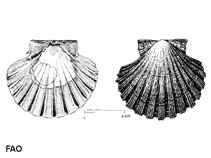
Bivalvia |
Pectinida |
Pectinidae
Milieu: milieu / Klimaatzone / Diepte / verspreidingsgebied
Ecologie
Benthic; diepte 0 - 500 m (Ref. 356), usually 0 - 30 m (Ref. 437). Subtropical, preferred 20°C (Ref. 107945); 45°N - 28°S, 29°W - 36°E
Eastern Atlantic and Mediterranean Sea: from Portugal to Canary Islands, Azores Island then east to Lebanon.
Lengte bij maturiteit / Grootte / Gewicht / Leeftijd
Maturiteit: Lm ?, range 5 - 6 cm Max length : 25.0 cm SHL mannelijk / geslacht onbekend; (Ref. 356); common length : 10.0 cm SHL mannelijk / geslacht onbekend; (Ref. 437)
Levenscyclus en paargedrag
Maturiteit | Voortplanting | Paaien | Eieren | Fecunditeit | Larven
Life cycle: Embryos develop into free-swimming trocophore larvae, succeeded by the bivalve veliger, resembling a miniature clam (Ref. 833).
SAUP Database 2006 SAUP Database. www.seaaroundus.org. (Ref. 356)
Status op de Rode Lijst van het IUCN
(Ref. 130435: Version 2025-2 (Global))
CITES status (Ref. 108899)
Not Evaluated
Not Evaluated
Gevaar voor de mens
Gebruik door de mens
Visserij: commercieel
FAO - visserij: landings search; Publication: search | FishSource | Sea Around Us
Tools
Meer informatie
FysiologieZuurstofverbruik
Menselijk gerelateerdPostzegels, munten, diversen.
Internetbronnen
Schattingen op basis van modellen
Rate of population increase
|
Prior r = 0.43, 95% CL = 0.29 - 0.65, Based on 1 full stock assessment. |
Kwetsbaarheid van de visserij
(Ref. 71543) |
Moderate vulnerability (37 of 100). |
Kwetsbaarheid voor het klimaat
(Ref. 125649) |
High vulnerability (64 of 100) |
Prijsklasse
(Ref. 80766): |
Very high. |
Nutrients
|
Calcium = 149 [71, 228] mg/100g; Iron = 8.53 [1.95, 15.11] mg/100g; Protein = 9.88 [8.64, 11.12] %; Omega3 = 0.313 [0.202, 0.423] g/100g; Selenium = 61 [50, 72] μg/100g; VitaminA = 0 μg/100g; Zinc = 2.04 [0.56, 3.51] mg/100g (wet weight); based on nutrient studies. |