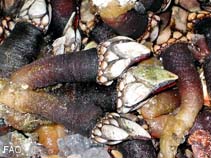
Thecostraca |
Pollicipedomorpha |
Pollicipedidae
สิ่งแวดล้อม : สิ่งแวดล้อม / เขตภูมิอากาศ / ระดับความลึก / ระยะการกระจายสินค้า
นิเวศวิทยา
Sessile; ระดับความลึก 0 - 200 m (อ้างอิง 356). Subtropical, preferred 19°C (อ้างอิง 107945); 50°N - 15°N, 19°W - 6°E
Northeast Atlantic and the Mediterranean.
ความยาวเมื่อครบกำหนดครั้งแรก / ขนาด / น้ำหนัก / อายุ
วัยเจริญพันธุ์: Lm ? range ? - ? cm Max length : 12.0 cm TL เพศผู้/กระเทย; (อ้างอิง 101388)
Exposed to heavy swell on rocky intertidal areas. Typically associated with cliffs and deep channels (Ref. 106932). Natural diet requires more studies. Its related species P. polymerus feed on diatoms, detritus, pelagic crustaceans, phytoplankton, microalgae, copepods and polychaetes; to be replaced with a better reference (Ref. 113151).
วงจรชีวิตและพฤติกรรมการผสมพันธุ์
วัยเจริญพันธุ์ | การสืบพันธุ์ | การวางไข่ | เซลสืบพันธ์ของเพศเมีย(ไข่) | ความดกของไข่ | ตัวอ่อน
Members of the superorder Thoracica are mostly hermaphroditic. Broadcast spawners, fertilization occurs in the mantle cavity. Life cycle: Eggs hatch into planktonic nauplii and leave the mantle cavity. Afterwards, they undergo six naupliar instars succeded by nonfeeding cypris larva (settling stage) which later metamorphose into adults (Ref. 833). Species is a simultaneous hermaphrodite (Ref. 117168).
MarineSpecies.org 2050 MarineSpecies.org. http://www.marinespecies.org/index.php (อ้างอิง 3477)
สถานะบัญชีแดงของ IUCN
(อ้างอิง 130435: Version 2025-2 (Global))
สถานะไซเตส (อ้างอิง 108899)
Not Evaluated
CMS (อ้างอิง 116361)
Not Evaluated
ภัยคุกคามต่อมนุษย์
การใช้ของมนุษย์
การประมง: การค้า
FAO - การประมง: landings search; Publication: search | FishSource | ทะเลรอบๆเรา
เครื่องมือ
ข้อมูลเพิ่มเติม
นิเวศวิทยาเขตร้อนรายการอาหาร (เหยื่อ)
องค์ประอบของอาหาร
การบริโภคอาหาร
ผู้ล่า
พลวัตของประชากรการเจริญเติบโต
อายุสูงสุด / ขนาด
ความยาว-น้ำหนักสัมพันธ์
ความยาว-ความยาวสัมพันธ์
ความยาว-ความถี่
การแปลงมวล
อุดมสมบรูณ์
วงจรชีวิตการสืบพันธุ์วัยเจริญพันธุ์ความดกของไข่การวางไข่เซลสืบพันธ์ของเพศเมีย(ไข่)การพัฒนาไข่ตัวอ่อน เกี่ยวข้องกับมนุษย์แสตมป์ เหรียญ อื่นๆ
แหล่งที่มาจากอินเตอร์เน็ต
การประมาณค่าตามแบบจำลอง
ความเสี่ยงต่อการตกปลา
(อ้างอิง 71543) |
Low vulnerability (10 of 100). |
ความเสี่ยงต่อสภาพภูมิอากาศ
(อ้างอิง 125649) |
High vulnerability (60 of 100) |
หมวดหมู่ราคา
(อ้างอิง 80766): |
Very high. |
Nutrients
|
Calcium = 126 [75, 177] mg/100g; Iron = 4.79 [1.67, 7.92] mg/100g; Protein = 16.6 [15.4, 17.8] %; Omega3 = 0.331 [0.263, 0.400] g/100g; Selenium = 57.8 [48.5, 67.2] μg/100g; VitaminA = 0 μg/100g; Zinc = 1.97 [0.92, 3.02] mg/100g (wet weight); based on nutrient studies. |