Bivalvia |
Ostreida |
Pteriidae
Entorno: milieu / zona climática / rango de profundidad / gama de distribución
Ecología
Benthic; rango de profundidad 0 - 35 m (Referencia 348), usually 0 - 35 m (Referencia 75831). Tropical
Indo-West Pacific: from East Africa and the Red Sea to Fiji Islands; north to southern Japan and south to northern Queensland and Western Australia.
Longitud en la primera madurez / Tamaño / Peso / Edad
Madurez: Lm ? range ? - ? cm Max length : 30.0 cm SHL macho / no sexado; (Referencia 348); common length : 20.0 cm SHL macho / no sexado; (Referencia 348)
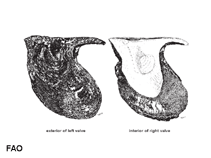
Shell solid, reaching a very large size, obliquely ovate in outline, with posterior ear drawn out into a narrow, more or less elongated, wing-like expansion; slightly inequivalve, left valve a little more inflated and with a weak rounded fold radiating from umbo to posteroventral end of shell. Outline of shell variable, initially narrowly oblique, later greatly expanding ventrally and almost as high as long, or even higher than long in larger specimens and with the posterior ear relatively short. Interior of shell with a wide non-nacreous margin ventrally. Colour: outside of shell plain dark brown to black. Interior silvery and brilliantly nacreous, with a broad, posteroventrally expanded, glossy black margin.
Found in intertidal areas on rocks (Ref. 75831). Sometimes attached to sea whips (Ref. 799). Also found subtidal, on dead coral heads (Ref. 75840).
Ciclo vital y comportamiento de apareamiento
Madurez | Reproducción | Puesta | Huevos | Fecundidad | Larva
Members of the class Bivalvia are mostly gonochoric, some are protandric hermaphrodites. Life cycle: Embryos develop into free-swimming trocophore larvae, succeeded by the bivalve veliger, resembling a miniature clam.
SAUP Database 2006 SAUP Database. www.seaaroundus.org. (Referencia 356)
Situación en la Lista Roja de la UICN
(Referencia 130435: Version 2025-2 (Global))
Estatus CITES (Referencia 108899)
Not Evaluated
CMS (Referencia 116361)
Not Evaluated
Amenaza para el ser humano
Usos humanos
Pesquerías: comercial
FAO - Aquaculture Systems: production search; Publication: search | FishSource | Sea Around Us
Herramientas
Más información
Dinámica de la poblaciónCrecimientoEdades / tallas máximasLongitud-peso rel.Longitud-longitud rel.Longitud-frecuenciasConversión de masasAbundancia Ciclo de vidaReproducciónMadurezFecundidadPuestaHuevosDesarrollo de los huevosLarva FisiologíaConsumo del oxígeno
Relacionados con el ser humanoSellos, monedas, varios
Fuentes de Internet
Estimaciones basadas en modelos
Vulnerabilidad pesquera
(Referencia 71543) |
Low vulnerability (20 of 100). |
Categoría de precios
(Referencia 80766): |
Unknown. |
Nutrients
|
Calcium = 149 [71, 228] mg/100g; Iron = 8.53 [1.95, 15.11] mg/100g; Protein = 9.88 [8.64, 11.12] %; Omega3 = 0.313 [0.202, 0.423] g/100g; Selenium = 61 [50, 72] μg/100g; VitaminA = 0 μg/100g; Zinc = 2.04 [0.56, 3.51] mg/100g (wet weight); based on nutrient studies. |