Bivalvia |
Ostreida |
Pinnidae
Meio ambiente: milieu / Zona climática / intervalo de profundidade / faixa de distribuição
Ecologia
Benthic; intervalo de profundidade 0 - 50 m (Ref. 75831). Tropical
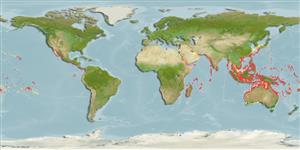
Indo-Pacific: from East Africa, including Madagascar, the Red Sea and the Persian Gulf, to eastern Polynesia; north to Japan and Hawaii, and south to Queensland and New Caledonia.
Comprimento de primeira maturação / Tamanho / Peso / Idade
Maturidade: Lm ? range ? - ? cm Max length : 48.0 cm SHL macho/indeterminado; (Ref. 348); common length : 30.0 cm SHL macho/indeterminado; (Ref. 348)
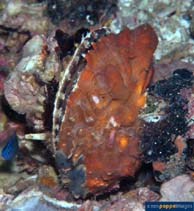
Shell reaching a very large size, thick and solid, inflated, variable in shape from triangular to hatchet-shaped or subglobular. Dorsal margin usually nearly straight, posterior margin broadly oval to somewhat truncate in outline. Ventral margin broadly convex posteriorly and concave near the umbones, often strongly lobate in medium-sized and large specimens. Outside of valves with 10 to 17 main radial ribs, often bearing scale-like spines, and with weaker interstitial riblets. Internal nacreous layer moderately strong, undivided, occupying the anterior half or 2/3 of valves. Hind margin of posterior adductor scar slightly protruding beyond the nacreous area (protrusion of adductor scar more developed in mature specimens). Colour: outside of shell dark reddish brown to nearly black, usually dull. Shell material semitranslucent, appearing a rich reddish purple when viewed with transmitted light. Interior dark brown to black, iridescent on nacreous area.
Because it attains a large size, this common species is probably one of the most economically important members of the family in the Indo-West Pacific. Beautiful but fragile black pearls are sometimes produced by the animal (Ref. 348). Intertidal to subtidal, on sand and mud (Ref. 75840).
Ciclo de vida ou comportamento de acasalamento
Maturidade | Reprodução | Desova | Ovos | Fecundidade | Larvas
Members of the class Bivalvia are mostly gonochoric, some are protandric hermaphrodites. Life cycle: Embryos develop into free-swimming trocophore larvae, succeeded by the bivalve veliger, resembling a miniature clam.
Poutiers, J.M. 1998 Bivalves. Acephala, Lamellibranchia, Pelecypoda. p. 123-362. In Carpenter, K. E. and V. H. Niem. 1998. FAO species identification guide for fishery purposes. The living marine resources of the Western Central Pacific. Volume 1. Seaweeds, corals, bivalves, and gastropods. Rome, FAO. (Ref. 348)
Status na Lista Vermelha da UICN
(Ref. 130435: Version 2025-2 (Global))
Status no CITES (Ref. 108899)
Not Evaluated
Not Evaluated
Ameaça para os humanos
Harmless
Uso pelos humanos
Pescarias: espécies comerciais
FAO - Publication: search | FishSource |
Ferramentas
Mais informação
Ecologia TróficaItens alimentares (presas)
Composição da dieta
Consumo alimentar
Predadores
Dinâmica populacionalCrescimentoIdade máxima / tamanhosRelação comprimento-peso.Relação comprimento-comprimento.Frequências de comprimentoConversão de massaAbundância Ciclo de vidaReproduçãoMaturidadeFecundidadeDesovaOvosDesenvolvimento dos ovosLarvas FisiologiaConsumo de oxigênio
Relacionado a humanosSelos, moedas, diversos.
Fontes da internet
Estimativas baseadas em modelos
Vulnerabilidade da pesca
(Ref. 71543) |
Moderate vulnerability (38 of 100). |
Categoria de preço
(Ref. 80766): |
Unknown. |