Malacostraca |
Decapoda |
Portunidae
Umwelt: Milieu / Klimazone / Tiefenbereich / Verbreitungsgebiet
Ökologie
Benthic. Tropical
Western Central Atlantic: confined to the Lake Maracaibo estuarine system.
Länge bei der ersten Reifung / Größe / Gewicht / Alter
Geschlechtsreife: Lm ? range ? - ? cm Max length : 16.0 cm WD Männchen/unbestimmt; (Ref. 367); 12 cm WD (female)
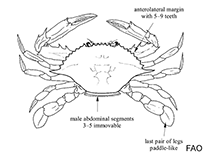
Carapace almost twice as broad as long; 9 teeth on moderately arched anterolateral margin (including outer orbital tooth and strong lateral spine) tending to be acuminate especially in outer part of row, with tips directed outward; front (excluding inner orbital angles) bearing 4 well-developed teeth, lateral pair moderately acute. Marginal slopes of convex dorsal surface smooth and glistening (when wet), central part and transverse lines variably granulate. Pincers granulate on ridges, fingers of major hand heavily toothed; fifth legs flattened in form of paddles. Male with T-shaped abdomen reaching to anterior 1/4 of thoracic sternite 4; slender first pleopods sinuously curved overlapping in 2 places proximally, diverging distally then recurving to termination near midline and tip of telson, armed distally with dorsolateral band of large and small retrogressive spinules. Color: carapace olive green with variable tints of brown and blue distally, articulations and spines of legs orange and blue; underparts cream and light yellow with suffusion of light blue.
Inhabits brackish to occasionally fresh waters containing much silt and decomposing organic material, usually below 16‰ salinity, on sandy and muddy bottoms and among roots of mangroves (Ref. 367).
Lebenszyklus und Paarungsverhalten
Geschlechtsreife | Fortpflanzung | Ablaichen | Eier | Fruchtbarkeit | Larven
Members of the order Decapoda are mostly gonochoric. Mating behavior: Precopulatory courtship ritual is common (through olfactory and tactile cues); usually indirect sperm transfer.
Tavares, M. 2003 True Crabs. pp. 327-352. In Carpenter, K.E. (ed.) The living marine resources of the Western Central Atlantic. Volume1: introdution, molluscs, crustaceans, hagfishes, sharks, batoid fishes, and chimaeras. FAO Species Identification Guide for Fishery Purposes and American Society of Ichthyologists and Herpetologists Special PublicationNo. 5. Rome, FAO. pp. 1-600. (Ref. 367)
IUCN Rote Liste Status
(Ref. 130435: Version 2025-2 (Global))
CITES Status (Ref. 108899)
Not Evaluated
Not Evaluated
Bedrohung für Menschen
Nutzung durch Menschen
Fischereien: weniger kommerziell
FAO - Publication: search | FishSource |
Tools
Mehr Information
Trophische ÖkologieLebensmittel (Beutetiere)
Nahrungszusammensetzung
Nahrungsaufnahme
Räuber
PopulationsdynamikWachstum
Max. Alter/Größen
Länge-Gewicht-Rel.
Länge-Länge-Verhältnis.
Längenhäufigkeiten
Massenkonvertierung
Dichte
LebenszyklusFortpflanzungGeschlechtsreifeFruchtbarkeitAblaichenEierEientwicklungLarven PhysiologieSauerstoffverbrauch
MenschenbezogenBriefmarken, Münzen, Verschiedenes.
Internet Quellen
Schätzungen auf der Grundlage von Modellen
Anfälligkeit der Fischerei
(Ref. 71543) |
Low vulnerability (10 of 100). |
Preiskategorie
(Ref. 80766): |
Very high. |