Gastropoda |
Pteropoda |
Clionidae
Environnement : milieu / zone climatique / profondeur / gamme de distribution
Écologie
Pélagique; profondeur 0 - 600 m (Réf. 2376). Temperate
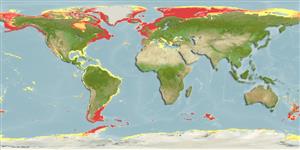
Cosmopolitan. Temperate to polar.
Longueur à la première maturité / Taille / Poids / Âge
Maturité: Lm ? range ? - ? cm Max length : 4.0 cm DL mâle / non sexé; (Réf. 83435)
It feeds on Spiratella sp. by everting its six, adhesive buccal cones; the prey is extracted completely from its shell by insertion of chitinous hooks into the prey's body (Ref. 92383). Also feeds on the thecosome Limacina sp. (Ref. 2376). It uses its wing-like parapodia to swim (Ref. 92384).
Cycle de vie et comportement reproducteur
Maturité | Reproduction | Frai | Œufs | Fécondité | Larves
Two distinct larval forms: shelled veliger hatches from the egg and later undergoes metamorphosis by losing its shell and develops into a polytrochous larva. The latter undergoes body elongation, growth of wings and disappearance of ciliary bands to adult stage.
Turgeon, D.D., J.F. Quinn Jr., A.E. Bogan, E.V. Coan, F.G. Hochberg, W.G. Lyons, P.M. Mikkelsen, R.J. Neves, C.F.E. Roper, G. Rosenberg, B. Roth, A. Scheltema, F.G. Thompson, M. Vecchione and J.D. Willams 1998 Common and scientific names of aquatic invertebrates from the United States and Canada: Mollusks, 2nd ed. American Fisheries Society (Special publication 26), Bethesda, Maryland. 526 p. (Réf. 1667)
Statut dans la liste rouge de l'IUCN
(Réf. 130435: Version 2025-2 (Global))
statut CITES (Réf. 108899)
Not Evaluated
Not Evaluated
Menace pour l'homme
Utilisations par l'homme
FAO - Publication: search | FishSource |
Outils
Plus d'informations
Dynamique des populations Cycle de vieReproductionMaturitéFéconditéFraiŒufsDéveloppement de l'œufLarves PhysiologieConsommation d'oxygène
Liées à l'hommeTimbres, pièces de monnaie, divers
Sources Internet
Estimations basées sur des modèles
Vulnérabilité de la pêche
(Réf. 71543) |
Low vulnerability (10 of 100). |
Catégorie de prix
(Réf. 80766): |
Unknown. |