Asteroidea |
Paxillosida |
Luidiidae
สิ่งแวดล้อม : สิ่งแวดล้อม / เขตภูมิอากาศ / ระดับความลึก / ระยะการกระจายสินค้า
นิเวศวิทยา
เกี่ยวกับหินโสโครก; ระดับความลึก 0 - 512 m (อ้างอิง 106682). Tropical
Indo-Pacific. Tropical to subtropical.
ความยาวเมื่อครบกำหนดครั้งแรก / ขนาด / น้ำหนัก / อายุ
วัยเจริญพันธุ์: Lm ? range ? - ? cm Max length : 60.0 cm WD เพศผู้/กระเทย; (อ้างอิง 129602)
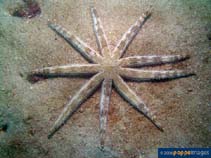
A large-sized starfish with seven to nine arms, eight being the most common. Aboral surface usually yellowish-brown, with four to six distinctive dark blotches on the arms. Central disc is very small, and long arms are tapered to a pointed end. Body surface is densely covered by abactinal paxillae, also having small sharp spines along the two sides of arms. Ambulacral groove is with two rows of tube feet that do not retract into the body.
Occurs on soft bottoms, exposed or buried in the sand (Also Ref. 129602) at depths of 0 to 90 m (Ref. 800). Also found on seagrass (Ref. 102259). Carnivorous and feeds on other echinoderms and mollusks (Ref. 800). Swallows prey as a whole, instead of protruding the stomach out to digest a prey (Ref. 125532).
วงจรชีวิตและพฤติกรรมการผสมพันธุ์
วัยเจริญพันธุ์ | การสืบพันธุ์ | การวางไข่ | เซลสืบพันธ์ของเพศเมีย(ไข่) | ความดกของไข่ | ตัวอ่อน
Members of the class Asteroidea exhibit both asexual (regeneration and clonal) and sexual (gonochoric) means of reproduction. Life cycle: Embryos hatch into planktonic larvae and later metamorphose into pentamorous juveniles which develop into young sea stars with stubby arms.
Schoppe, S. 2000 A guide to common shallow water sea stars, brittle stars, sea urchins, sea cucumbers and feather stars (echinoderms) of the Philippines. Times Media Private Limited, Singapore. 144 p. (อ้างอิง 800)
สถานะบัญชีแดงของ IUCN
(อ้างอิง 130435: Version 2025-2 (Global))
สถานะไซเตส (อ้างอิง 108899)
Not Evaluated
CMS (อ้างอิง 116361)
Not Evaluated
ภัยคุกคามต่อมนุษย์
Harmless
การใช้ของมนุษย์
FAO - Publication: search | FishSource |
เครื่องมือ
ข้อมูลเพิ่มเติม
พลวัตของประชากรการเจริญเติบโต
อายุสูงสุด / ขนาด
ความยาว-น้ำหนักสัมพันธ์
ความยาว-ความยาวสัมพันธ์
ความยาว-ความถี่
การแปลงมวล
อุดมสมบรูณ์
วงจรชีวิตการสืบพันธุ์วัยเจริญพันธุ์ความดกของไข่การวางไข่เซลสืบพันธ์ของเพศเมีย(ไข่)การพัฒนาไข่ตัวอ่อน เกี่ยวข้องกับมนุษย์แสตมป์ เหรียญ อื่นๆ
แหล่งที่มาจากอินเตอร์เน็ต
การประมาณค่าตามแบบจำลอง
ความเสี่ยงต่อการตกปลา
(อ้างอิง 71543) |
Moderate vulnerability (44 of 100). |
หมวดหมู่ราคา
(อ้างอิง 80766): |
Unknown. |