-

- About this page
- Languages
-
Feedback
- Citation
- Upload
-
Related species
- Species in
Mespilia - Species in
Temnopleuridae - - Classification -
- Temnopleuridae
- Camarodonta
- Echinoidea
- Chordata
- Animalia
- Species in
-



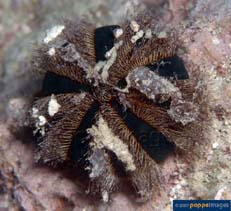
Mespilia globulus (Linnaeus, 1758)
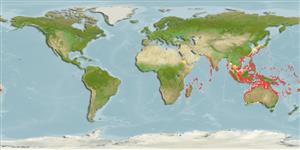
Globular sea urchin| Native range | All suitable habitat | Point map | Year 2050 |
|
| This map was computer-generated and has not yet been reviewed. |
| Mespilia globulus AquaMaps Data sources: GBIF OBIS |
Classification / Names आम नाम | उपशब्द | CoL | ITIS | WoRMS
Echinoidea | Camarodonta | Temnopleuridae
Environment: milieu / climate zone / गहराई सीमा / distribution range पारिस्थितिकी
प्रवाल-भित्ति संयुक्त; गहराई सीमा 0 - 80 m (संदर्भ 95661). Tropical
Distribution देश | ऐफ ऐ ओ क्षेत्र | Ecosystems | संयोग | भूमिका
Indo-Pacific.
Length at first maturity / आकार / Weight / Age
परिपक्व अवधि: Lm ? range ? - ? cm Max length : 5.0 cm WD पुल्लिंग / अलिंग; (संदर्भ 800)
Occurs in shallow water reef areas, coral rubble and seagrass beds at depths 0 to 60 m (Ref. 800). Attaches debris to its test. Ingests calcareous sediment while feeding on detritus (Ref. 102365).
Life cycle and mating behavior परिपक्व अवधि | पुनरुत्पत्ति | मछलीऔ का अंडे देना | Eggs | Fecundity | Larvae
Members of the class Echinoidea are gonochoric. Fertilization is external. Brooding is common, eggs are held either on the peristome, around the periproct or deep into the concavities on the petaloids. Life cycle: Embryos develop into planktotrophic larvae (echinoplateus) and live for several months before they sink to the bottom using their tube feet to adhere on the ground where they metamorphose into young urchins.
Main reference
संदर्भ | संयोजक | सहयोगीयो
Schoppe, S. 2000 A guide to common shallow water sea stars, brittle stars, sea urchins, sea cucumbers and feather stars (echinoderms) of the Philippines. Times Media Private Limited, Singapore. 144 p. (संदर्भ 800)
IUCN Red List Status
(संदर्भ 130435: Version 2025-1)
CITES status (संदर्भ 108899)
Not Evaluated
CMS (संदर्भ 116361)
Not Evaluated
Threat to humans
Harmless
Human uses
| FishSource |
साधन
अधिक जानकारी
Trophic Ecology
Food items (preys)
संघटक आहार
आहार खपत
परभक्षी
संघटक आहार
आहार खपत
परभक्षी
पारिस्थितिकी
Population dynamics
बाढ़
Max. ages / sizes
Length-weight rel.
Length-length rel.
Length-frequencies
Mass conversion
बहुतायत
Max. ages / sizes
Length-weight rel.
Length-length rel.
Length-frequencies
Mass conversion
बहुतायत
Life cycle
Distribution
Physiology
Oxygen consumption
इंटरनेट स्रोत
BHL | BOLD Systems | CISTI | DiscoverLife | FAO(Publication : search) | Fishipedia | GenBank (genome, nucleotide) | GloBI | Gomexsi | Google Books | Google Scholar | Google | PubMed | Tree of Life | Wikipedia (Go, खोज) | Zoological Record
Estimates based on models
Preferred temperature
(Ref. 115969): 22.6 - 28.9, mean 27.5 (based on 806 cells).
Price category
(संदर्भ 80766):
Unknown.