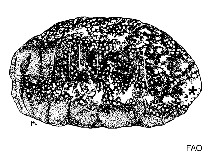
Holothuroidea |
Holothuriida |
Holothuriidae
Miljö: miljö / Klimatzon / djupintervall / distributionsområde
Ekologi
Benthic; djupintervall 0 - 20 m (Ref. 81020). Tropical
Indo-Pacific: East Africa to Hawaii, western coasts of North America; the Panamanian region; Galapagos Island, Philippines and the West Indies.
Längd vid första mognad / Storlek / Vikt / Ålder
Könsmognad: Lm ? range ? - ? cm Max length : 18.0 cm TL hane/ej könsbestämd; (Ref. 800)
This is a burrowing species that is usually found under rubble and sand (Ref. 85218). Species of the genus Holothuria are generally mobile deposit feeders (Ref. 833).
Livscykel och parningsbeteende
Könsmognad | Reproduktion | Lek | Ägg | Fekunditet | Larver
Members of the class Holothuroidea are gonochoric and have only one gonad. Spawning and fertilization are both external and some exhibit brooding. Life cycle: Embryos develop into planktotrophic larvae (auricularia) then into doliolaria (barrel-shaped stage) which later metamorphose into juvenile sea cucumbers.
Schoppe, S. 2000 A guide to common shallow water sea stars, brittle stars, sea urchins, sea cucumbers and feather stars (echinoderms) of the Philippines. Times Media Private Limited, Singapore. 144 p. (Ref. 800)
Status på IUCN:s rödlista
(Ref. 130435: Version 2025-2 (Global))
CITES-status (Ref. 108899)
Not Evaluated
Not Evaluated
Hot mot människor
Harmless
Mänskliga användningsområden
FAO - Publication: search | FishSource |
Verktyg
Ytterligare information
Trofisk ekologiLivsmedelsartiklar (preys)
Födosammansättning
Födointag
Predatorer
LivscykelReproduktionKönsmognadFekunditetLekÄggUtveckling av äggLarver MänniskorelateradFrimärken, mynt, diverse.
Internet-källor
Uppskattningar baserade på modeller
Sårbarhet i fisket
(Ref. 71543) |
Low vulnerability (10 of 100). |
Priskategori
(Ref. 80766): |
Unknown. |