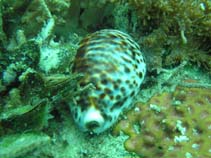
Gastropoda |
Littorinimorpha |
Cypraeidae
Miljö: miljö / Klimatzon / djupintervall / distributionsområde
Ekologi
Benthic; djupintervall 0 - 30 m (Ref. 349). Tropical; 35°N - 34°S, 30°E - 138°W
Indo-Pacific.
Längd vid första mognad / Storlek / Vikt / Ålder
Könsmognad: Lm ? range ? - ? cm Max length : 16.0 cm SHL hane/ej könsbestämd; (Ref. 349); common length : 9.0 cm SHL hane/ej könsbestämd; (Ref. 349)
Commonly collected for food in many parts of the area, mainly in the shallow water zone. Shell used for shellcraft. Due to frequent over collecting and destruction of the coral reef environment by dynamite fishers, this species may be nearly extinct locally or confined to the deeper part of its habitat (to depths over 10 m) (Ref. 349). Known to be abundant in reef areas, on sand, among rocks (Ref. 128042), on branched corals, often nearby seaweeds. Active during the day (Ref. 349). Omnivore (Ref. 112158). In general, cowries are observed to feed on sponges, live gastropods, seaweed, and carrion (Ref. 112163).
Livscykel och parningsbeteende
Könsmognad | Reproduktion | Lek | Ägg | Fekunditet | Larver
Members of the order Neotaenioglossa are mostly gonochoric and broadcast spawners. Life cycle: Embryos develop into planktonic trocophore larvae and later into juvenile veligers before becoming fully grown adults.
Poutiers, J.M. 1998 Gastropods. p. 363-648. In Carpenter, K. E. and V. H. Niem. 1998. FAO species identification guide for fishery purposes. The living marine resources of the Western Central Pacific. Volume 1. Seaweeds, corals, bivalves, and gastropods. Rome, FAO. (Ref. 349)
Status på IUCN:s rödlista
(Ref. 130435: Version 2025-2 (Global))
CITES-status (Ref. 108899)
Not Evaluated
Not Evaluated
Hot mot människor
Harmless
Mänskliga användningsområden
Fiskeri: kommersiell
FAO - Publication: search | FishSource | Havet omkring oss
Verktyg
Ytterligare information
Trofisk ekologiLivsmedelsartiklar (preys)
Födosammansättning
Födointag
Predatorer
LivscykelReproduktionKönsmognadFekunditetLekÄggUtveckling av äggLarver MänniskorelateradFrimärken, mynt, diverse.
Internet-källor
Uppskattningar baserade på modeller
Sårbarhet i fisket
(Ref. 71543) |
Low vulnerability (10 of 100). |
Priskategori
(Ref. 80766): |
Unknown. |
Nutrients
|
Calcium = 126 [75, 177] mg/100g; Iron = 4.79 [1.67, 7.92] mg/100g; Protein = 15.9 [14.8, 16.9] %; Omega3 = 0.331 [0.263, 0.400] g/100g; Selenium = 57.8 [48.5, 67.2] μg/100g; VitaminA = 0 μg/100g; Zinc = 1.97 [0.92, 3.02] mg/100g (wet weight); based on nutrient studies. |