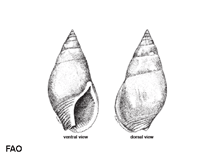
Gastropoda |
Neogastropoda |
Nassariidae
Milieu: milieu / Klimaatzone / Diepte / verspreidingsgebied
Ecologie
Benthic. Tropical
Indo-West Pacific: from the Andaman Sea to Melanesia; north to Japan and south to northern New South Wales.
Lengte bij maturiteit / Grootte / Gewicht / Leeftijd
Maturiteit: Lm ? range ? - ? cm Max length : 4.5 cm ShH mannelijk / geslacht onbekend; (Ref. 349); common length : 3.5 cm SHL mannelijk / geslacht onbekend; (Ref. 349)
Locally collected as food for the shell, which is utilized in shellcraft (Ref. 349). Common on muddy sand flats (Ref. 349). Seeks shelter by burrowing in sand. Actively forages for food during low tide. A scavenger most of the time but also a predator (Ref. 101234).
Levenscyclus en paargedrag
Maturiteit | Voortplanting | Paaien | Eieren | Fecunditeit | Larven
This species is a non-broadcast spawner. Life cycle does not include trocophore stage. Also Ref. 833.
Poutiers, J.M. 1998 Gastropods. p. 363-648. In Carpenter, K. E. and V. H. Niem. 1998. FAO species identification guide for fishery purposes. The living marine resources of the Western Central Pacific. Volume 1. Seaweeds, corals, bivalves, and gastropods. Rome, FAO. (Ref. 349)
Status op de Rode Lijst van het IUCN
(Ref. 130435: Version 2025-2 (Global))
CITES status (Ref. 108899)
Not Evaluated
Not Evaluated
Gevaar voor de mens
Harmless
Gebruik door de mens
FAO - Publication: search | FishSource |
Tools
Meer informatie
LevenscyclusVoortplantingMaturiteitFecunditeitPaaienEierenOntwikkeling van de eierenLarven FysiologieZuurstofverbruik
Menselijk gerelateerdPostzegels, munten, diversen.
Internetbronnen
Schattingen op basis van modellen
Kwetsbaarheid van de visserij
(Ref. 71543) |
Low vulnerability (10 of 100). |
Prijsklasse
(Ref. 80766): |
Unknown. |