Polyplacophora |
Chitonida |
Ischnochitonidae
Environnement : milieu / zone climatique / profondeur / gamme de distribution
Écologie
Benthic; profondeur 0 - 24 m (Réf. 107695). Tropical
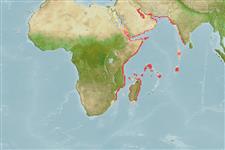
Western Indian Ocean.
Longueur à la première maturité / Taille / Poids / Âge
Maturité: Lm ? range ? - ? cm
Minimum depth from Ref. 1726. Intertidal to shallow subtidal. Found under medium-sized granite rocks or dead coral slabs, slightly buried in coarse sand (Ref. 1726). Most chitons are microphagous feeders that consume fine algae and other organisms they scrape via their radula (Ref. 833).
Cycle de vie et comportement reproducteur
Maturité | Reproduction | Frai | Œufs | Fécondité | Larves
Members of the class Polyplacophora are mostly gonochoric. Life cycle: Eggs hatch into lecitotrophic planktonic trocophore larvae (no veliger stage) which later metamorphose and settle on the bottom as young adults.
Dell'Angelo, B., A. Bonfitto, M. Taviani and B. Sabelli 2003 Chitons (Mollusca, Polyplacophora) from bioclastic sands of the Ifaty-Tuléar back reefs (Madagascar, Western Indian Ocean). Bolletino Malacologico 5:45-62. (Réf. 703)
Statut dans la liste rouge de l'IUCN
(Réf. 130435: Version 2025-2 (Global))
statut CITES (Réf. 108899)
Not Evaluated
Not Evaluated
Menace pour l'homme
Harmless
Utilisations par l'homme
FAO - Publication: search | FishSource |
Outils
Plus d'informations
Écologie trophiqueAliments (proies)
Composition du régime alimentaire
Consommation alimentaire
Prédateurs
Dynamique des populationsCroissance
Âges / tailles maximales
Longueur-poids rel.
Rel. longueur-longueur.
Fréquences de longueurs
Conversion de masse
Abondance
Cycle de vieReproductionMaturitéFéconditéFraiŒufsDéveloppement de l'œufLarves PhysiologieConsommation d'oxygène
Liées à l'hommeTimbres, pièces de monnaie, divers
Sources Internet
Estimations basées sur des modèles
Vulnérabilité de la pêche
(Réf. 71543) |
(0 of 100). |
Catégorie de prix
(Réf. 80766): |
Unknown. |