Gastropoda |
Nudibranchia |
Hexabranchidae
Environnement : milieu / zone climatique / profondeur / gamme de distribution
Écologie
Benthic; profondeur 1 - 50 m (Réf. 121225), usually 10 - 20 m (Réf. 866). Tropical; 37°N - 36°S, 30°E - 144°W
Indo-Pacific: from East Africa to Red Sea, east to French Polynesia, north to Japan, and south to Australia and New Caledonia.
Longueur à la première maturité / Taille / Poids / Âge
Maturité: Lm ? range ? - ? cm Max length : 25.0 cm TL mâle / non sexé; (Réf. 100471)
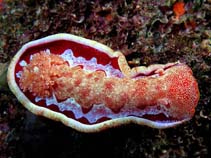
Maximum length is based on data from Marshall Islands (Ref. 100471). Found in coral reefs at depths of 10 to 20 m (Ref. 866). Derives a potent chemical defense from Halichondria sp., a sponge that it eats. It displays a spectacular swimming response - it throws its body into sweeping dorsoventral flexions creating synchronous undulations through its broad and vividly patterned red and white mantle (Ref. 100471).
Cycle de vie et comportement reproducteur
Maturité | Reproduction | Frai | Œufs | Fécondité | Larves
Eggs are deposited as coiled rosettes on rocks and coral rubble (Ref. 100471).
Gosliner, T. 1987 Nudibranchs of Southern Arfrica: A guide to opistobranch molluscs of Southern Africa. Sea Challengers and Jeff Hamann in association with the California Academy of Sciences. 136 pp. (Réf. 866)
Statut dans la liste rouge de l'IUCN
(Réf. 130435: Version 2025-2 (Global))
statut CITES (Réf. 108899)
Not Evaluated
Not Evaluated
Menace pour l'homme
Harmless
Utilisations par l'homme
Pêcheries: commercial
FAO - Publication: search | FishSource | Sea Around Us
Outils
Plus d'informations
Dynamique des populationsCroissanceÂges / tailles maximalesLongueur-poids rel.Rel. longueur-longueur.Fréquences de longueursConversion de masseAbondance PhysiologieConsommation d'oxygène
Liées à l'hommeTimbres, pièces de monnaie, divers
Sources Internet
Estimations basées sur des modèles
Vulnérabilité de la pêche
(Réf. 71543) |
Low vulnerability (15 of 100). |
Catégorie de prix
(Réf. 80766): |
Unknown. |
Nutrients
|
Calcium = 126 [75, 177] mg/100g; Iron = 4.79 [1.67, 7.92] mg/100g; Protein = 15.9 [14.8, 16.9] %; Omega3 = 0.331 [0.263, 0.400] g/100g; Selenium = 57.8 [48.5, 67.2] μg/100g; VitaminA = 0 μg/100g; Zinc = 1.97 [0.92, 3.02] mg/100g (wet weight); based on nutrient studies. |