Gastropoda |
Nudibranchia |
Gymnodorididae
Milieu: milieu / Klimaatzone / Diepte / verspreidingsgebied
Ecologie
Benthic; diepte 0 - 30 m (Ref. 7727). Tropical
Indo-Pacific.
Lengte bij maturiteit / Grootte / Gewicht / Leeftijd
Maturiteit: Lm ? range ? - ? cm
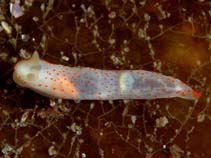
White with orange spots and usually an orange border reaching the pointed head region of the mantle. Gills are translucent white, having an orange line along the outer axis of the upper half of each gill. The translucent white rhinophore club is tipped with orange. Posterior end of the foot is either tipped with orange or has an orange median line.
Inhabits coral rubble at depths of 1 to 2 m (Ref. 866). Observed feeding on aeolid nudibranchs (Ref. 79924).
Levenscyclus en paargedrag
Maturiteit | Voortplanting | Paaien | Eieren | Fecunditeit | Larven
Members of the order Nudibranchia are simultaneous hermaphrodites. Mating behavior: Both individuals darts their penis toward each other to induce one to act as a male and the other as the female. The victorious one to penetrate the body wall is the dominant male. Life cycle: Eggs are deposited on a substratum where they develop and hatch into (planktonic) vestigial veliger larval stage and further grow as adults.
Gosliner, T. 1987 Nudibranchs of Southern Arfrica: A guide to opistobranch molluscs of Southern Africa. Sea Challengers and Jeff Hamann in association with the California Academy of Sciences. 136 pp. (Ref. 866)
Status op de Rode Lijst van het IUCN
(Ref. 130435: Version 2025-2 (Global))
CITES status (Ref. 108899)
Not Evaluated
Not Evaluated
Gevaar voor de mens
Harmless
Gebruik door de mens
FAO - Publication: search | FishSource |
Tools
Meer informatie
Trofische ecologieVoedsel (prooien)
Dieetsamenstelling
Voedselconsumptie
Predatoren
PopulatiedynamicaGroei
Max. leeftijden / maten
Lengte-gewicht rel.
Lengte-lengte rel.
Lengtefrequenties
Massaconversie
Abundantie
LevenscyclusVoortplantingMaturiteitFecunditeitPaaienEierenOntwikkeling van de eierenLarven FysiologieZuurstofverbruik
Menselijk gerelateerdPostzegels, munten, diversen.
Internetbronnen
Schattingen op basis van modellen
Kwetsbaarheid van de visserij
(Ref. 71543) |
(0 of 100). |
Prijsklasse
(Ref. 80766): |
Unknown. |