Thecostraca |
Balanomorpha |
Chthamalidae
Environnement : milieu / zone climatique / profondeur / gamme de distribution
Écologie
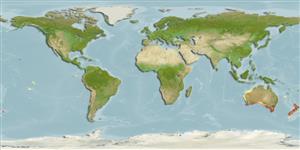
Sessile. Subtropical; 15°S - 48°S, 112°E - 147°W
Indo-Pacific.
Longueur à la première maturité / Taille / Poids / Âge
Maturité: Lm ? range ? - ? cm Max length : 0.1 cm WD mâle / non sexé; (Réf. 3547)
Known from high spring to low spring tide. Found on rocks, concrete, wood and other invertebrates: Eliminius plicatus, Chamaesipho brunnea, Mitella sertus, Eliminius modestus, Mytilus canaliculus, Mytilus planulatus, Lunella smaragda, Lepsiella scobina, Neothais haustrum, Lepsia succincta, Nerita melanotragus, Anisodiloma lugubris, Melagraphia oethiops, Siphonaria spp., Sipharochiton pellisserpentis, Guildingia obtecta, and Epopella kermadeca. Feeding observed after 48 hours of being dry (Ref. 3547).
Cycle de vie et comportement reproducteur
Maturité | Reproduction | Frai | Œufs | Fécondité | Larves
Members of the superorder Thoracica are mostly hermaphroditic. Broadcast spawners, fertilization occurs in the mantle cavity. Life cycle: Eggs hatch into planktonic nauplii and leave the mantle cavity. Afterwards, they undergo six naupliar instars succeded by nonfeeding cypris larva (settling stage) which later metamorphose into adults.
Moore, L.B. 1944 Some intertidal sessile barnacles of New Zealand. Transactions of the Royal Society of New Zealand 73:315-334. (Réf. 3547)
Statut dans la liste rouge de l'IUCN
(Réf. 130435: Version 2025-2 (Global))
statut CITES (Réf. 108899)
Not Evaluated
Not Evaluated
Menace pour l'homme
Harmless
Utilisations par l'homme
FAO - Publication: search | FishSource |
Outils
Plus d'informations
Écologie trophiqueAliments (proies)
Composition du régime alimentaire
Consommation alimentaire
Prédateurs
Dynamique des populationsCroissance
Âges / tailles maximales
Longueur-poids rel.
Rel. longueur-longueur.
Fréquences de longueurs
Conversion de masse
Abondance
Cycle de vieReproductionMaturitéFéconditéFraiŒufsDéveloppement de l'œufLarves PhysiologieConsommation d'oxygène
Liées à l'hommeTimbres, pièces de monnaie, divers
Sources Internet
Estimations basées sur des modèles
Vulnérabilité de la pêche
(Réf. 71543) |
Low vulnerability (10 of 100). |