Malacostraca |
Decapoda |
Portunidae
Umwelt: Milieu / Klimazone / Tiefenbereich / Verbreitungsgebiet
Ökologie
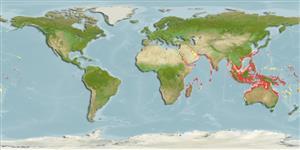
Benthopelagisch; brackwasser; tiefenbereich 0 - 51 m (Ref. 74519), usually 0 - 30 m (Ref. 106819). Tropical; 30°N - 31°S, 29°E - 154°W
Indo-Pacific. Introduced in the Atlantic and the Mediterranean Sea. Subtropical to tropical.
Länge bei der ersten Reifung / Größe / Gewicht / Alter
Geschlechtsreife: Lm ?, range 4 - ? cm Max length : 7.9 cm CW Männchen/unbestimmt; (Ref. 77880); 7.7 cm CW (female); common length : 4.7 cm CW Männchen/unbestimmt; (Ref. 93549); max. veröff. Alter: 3.00 Jahre (Ref. 108232)
Pref min-pref max estimated. Assumed common length range: 3.62 to 4.7 cm CW (Ref. 93549). Benthopelagic (Ref. 97531). Prefers soft bottoms (Ref. 103831), with sandy to muddy substrates (Ref. 106287). Found on rocky coast and on coral reefs (Ref. 121712). Intertidal, found under rocks and stones and among live corals (Ref. 95903); also on rubble (Ref. 97531). Also found in an estuary-bay complex (Ref. 121721) as well as on the roots of the mangrove Rhizophora mangle (Ref. 103831) and the seagrass Halophila stipulacea (Ref. 119437).
Mating behavior: Precopulatory courtship ritual is common (through olfactory and tactile cues); usually indirect sperm transfer (Ref. 833).
Benson, A.J., P.L. Fuller and C.C. Jacono 2001 Summary Report of Ninindigenous Aquatic Species in U.S. Fish and Wildlife Service Region 4. U.S. Geological Survey Florida Caribbean Science Center. (Ref. 8125)
IUCN Rote Liste Status
(Ref. 130435: Version 2025-2 (Global))
CITES Status (Ref. 108899)
Not Evaluated
Not Evaluated
Bedrohung für Menschen
Nutzung durch Menschen
Fischereien: kommerziell
FAO - Publication: search | FishSource |
Tools
Mehr Information
PhysiologieSauerstoffverbrauch
MenschenbezogenBriefmarken, Münzen, Verschiedenes.
Internet Quellen
Schätzungen auf der Grundlage von Modellen
Anfälligkeit der Fischerei
(Ref. 71543) |
Low vulnerability (16 of 100). |
Preiskategorie
(Ref. 80766): |
Unknown. |