Hydrozoa |
Leptothecata |
Sertulariidae
Umwelt: Milieu / Klimazone / Tiefenbereich / Verbreitungsgebiet
Ökologie
Demersal; tiefenbereich 90 - 522 m (Ref. 7416). Polar
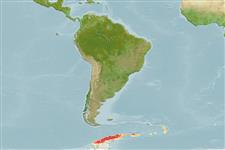
Antarctic Atlantic: South Shetland and Antarctica.
Länge bei der ersten Reifung / Größe / Gewicht / Alter
Geschlechtsreife: Lm ? range ? - ? cm Max length : 1.5 cm H Männchen/unbestimmt; (Ref. 7416)
Tiny stems up to ca 0.5 cm long. Stem internodes long and distinctly arranged in zig-zag fashion. Hydrothecae situated at the end of stem internode. Hydrotheca almost tubular and directed up- and outwards. Hydrotheca free for most of its adcauline wall; free part of adcauline hydrothecal wall straight. Hydrotheca with a distinct inflexion point where adcauline wall becomes free. Abcauline wall straight or slightly abcaudally directed at its distal part. Cusps of hydrothecal aperture sharp and separated by deep embayments. Hydrotheca widening at the aperture.
Found at depths of 90 to 522 m; on Bryozoans and hydroids (Ref. 7416).
Lebenszyklus und Paarungsverhalten
Geschlechtsreife | Fortpflanzung | Ablaichen | Eier | Fruchtbarkeit | Larven
Members of the order Leptothecata include L-form hydroids. Life cycle: The zygote develops into planula and later into polyp then into free-swimming medusa.
Peña Cantero, A.L., A. Svoboda and W. Vervoort 2002 Species of Stymplectoscyphus Marktanner-Turneretscher, 1980 (Cnidaria; Hydrozoa: Sertulariidae) from recent Antarctic expeditions with R.V. Polarsten, with the description of four new species. Journal of Natural History 36:1509-1568. (Ref. 7416)
IUCN Rote Liste Status
(Ref. 130435: Version 2025-2 (Global))
CITES Status (Ref. 108899)
Not Evaluated
Not Evaluated
Bedrohung für Menschen
Harmless
Nutzung durch Menschen
FAO - Publication: search | FishSource |
Tools
Mehr Information
Trophische ÖkologieLebensmittel (Beutetiere)
Nahrungszusammensetzung
Nahrungsaufnahme
Räuber
PopulationsdynamikWachstum
Max. Alter/Größen
Länge-Gewicht-Rel.
Länge-Länge-Verhältnis.
Längenhäufigkeiten
Massenkonvertierung
Dichte
LebenszyklusFortpflanzungGeschlechtsreifeFruchtbarkeitAblaichenEierEientwicklungLarven PhysiologieSauerstoffverbrauch
MenschenbezogenBriefmarken, Münzen, Verschiedenes.
Internet Quellen
Schätzungen auf der Grundlage von Modellen
Anfälligkeit der Fischerei
(Ref. 71543) |
Low vulnerability (10 of 100). |