Hydrozoa |
Leptothecata |
Sertulariidae
Environnement : milieu / zone climatique / profondeur / gamme de distribution
Écologie
Sessile; profondeur 7 - 457 m (Réf. 7416). Polar
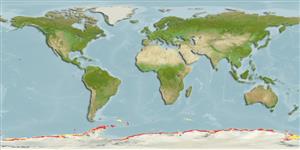
Circum-Antarctic.
Longueur à la première maturité / Taille / Poids / Âge
Maturité: Lm ? range ? - ? cm Max length : 2.5 cm H mâle / non sexé; (Réf. 7416)
Description synthétique
Morphologie
Delicate and monosiphonic stems up to 2.5 cm high. Branching frequent. Some branches forming stolons and anastomosing amongst them. Hydrothecal internodes long and thin, usually longer than hydrothecae. Hydrothecae situated at distal part of internode and alternately arranged in one plane. Hydrothecae almost cylindrical, slightly abcaudally directed. Adcauline hydrothecal wall free for approximately two-thirds its length. Free part
of adcauline hydrothecal wall convex. Abcauline hydrothecal wall slightly concave. Cusps of hydrothecal aperture sharp and separated by deep embayments. Hydrothecae extremely delicate; frequently collapsed. Gonothecae fusiform, with waved walls and a short distal neck bearing the aperture.
Known at depths of 7 to 457 m; on muddy, rocky, boulders, sand, stones and detritus materials (Ref. 7416).
Cycle de vie et comportement reproducteur
Maturité | Reproduction | Frai | Œufs | Fécondité | Larves
Found with gonothecae from June to August; January and February and January to December. The material was collected in February.
Peña Cantero, A.L., A. Svoboda and W. Vervoort 2002 Species of Stymplectoscyphus Marktanner-Turneretscher, 1980 (Cnidaria; Hydrozoa: Sertulariidae) from recent Antarctic expeditions with R.V. Polarsten, with the description of four new species. Journal of Natural History 36:1509-1568. (Réf. 7416)
Statut dans la liste rouge de l'IUCN
(Réf. 130435: Version 2025-2 (Global))
statut CITES (Réf. 108899)
Not Evaluated
Not Evaluated
Menace pour l'homme
Harmless
Utilisations par l'homme
FAO - Publication: search | FishSource |
Outils
Plus d'informations
Écologie trophiqueAliments (proies)
Composition du régime alimentaire
Consommation alimentaire
Prédateurs
Dynamique des populationsCroissance
Âges / tailles maximales
Longueur-poids rel.
Rel. longueur-longueur.
Fréquences de longueurs
Conversion de masse
Abondance
Cycle de vieReproductionMaturitéFéconditéFraiŒufsDéveloppement de l'œufLarves PhysiologieConsommation d'oxygène
Liées à l'hommeTimbres, pièces de monnaie, divers
Sources Internet
Estimations basées sur des modèles
Vulnérabilité de la pêche
(Réf. 71543) |
Low vulnerability (10 of 100). |