Polychaeta |
Sabellida |
Serpulidae
Environnement : milieu / zone climatique / profondeur / gamme de distribution
Écologie
Sessile; profondeur 3 - 10 m (Réf. 125532). Tropical
Indo-West Pacific.
Longueur à la première maturité / Taille / Poids / Âge
Maturité: Lm ? range ? - ? cm
Description synthétique
Morphologie
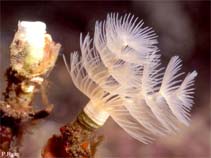
Body is 6 to 10 cm in length, including the worm tube; diameter can reach 20 cm when the two branchial crowns fully open. The branchial crown is made up of white radioles (can reach up to 80) arranged in three spiral whorls, each covered with closely packed small cilia. Crown is white, and base varies from red to pink.
In coral sand and rock crevices (Ref. 107830). Occur in shallow waters, from depths of 3 to 10 meters. Filter feeder. Sensitive to water movement and fluctuation in light intensity. Easily retracts into its calcareous tube when it detects movement nearby (Ref. 125532).
Cycle de vie et comportement reproducteur
Maturité | Reproduction | Frai | Œufs | Fécondité | Larves
Members of the class Polychaeta are mostly gonochoric (sexual). Mating: Females produce a pheromone attracting and signalling the males to shed sperm which in turn stimulates females to shed eggs, this behavior is known as swarming. Gametes are spawned through the metanephridia or body wall rupturing (termed as "epitoky", wherein a pelagic, reproductive individual, "epitoke", is formed from a benthic, nonreproductive individual, "atoke"). After fertilization, most eggs become planktonic; although some are retained in the worm tubes or burrowed in jelly masses attached to the tubes (egg brooders). Life Cycle: Eggs develop into trocophore larva, which later metamorph into juvenile stage (body lengthened), and later develop into adults.
Wehe, T. and D. Fiege 2002 Annotated checklist of the polychaete species of the seas surrounding the Arabian Peninsula: Red Sea, Gulf of Aden, Arabian Sea, Gulf of Oman, Arabian Gulf. Fauna of Arabia 19:7-238. (Réf. 2663)
Statut dans la liste rouge de l'IUCN
(Réf. 130435: Version 2025-2 (Global))
statut CITES (Réf. 108899)
Not Evaluated
Not Evaluated
Menace pour l'homme
Harmless
Utilisations par l'homme
FAO - Publication: search | FishSource |
Outils
Plus d'informations
Écologie trophiqueAliments (proies)
Composition du régime alimentaire
Consommation alimentaire
Prédateurs
Dynamique des populationsCroissance
Âges / tailles maximales
Longueur-poids rel.
Rel. longueur-longueur.
Fréquences de longueurs
Conversion de masse
Abondance
Cycle de vieReproductionMaturitéFéconditéFraiŒufsDéveloppement de l'œufLarves PhysiologieConsommation d'oxygène
Liées à l'hommeTimbres, pièces de monnaie, divers
Sources Internet
Estimations basées sur des modèles
Vulnérabilité de la pêche
(Réf. 71543) |
(0 of 100). |