Malacostraca |
Isopoda |
Chaetiliidae
Environment: milieu / climate zone / depth range / distribution range
Ecology
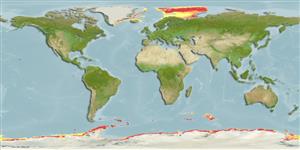
Benthic; depth range 0 - 580 m (Ref. 3113). Polar
Northeast Atlantic and the Antarctic.
Length at first maturity / Size / Weight / Age
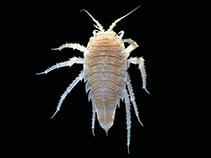
Maturity: Lm ? range ? - ? cm Max length : 9.0 cm TL male/unsexed; (Ref. 8360)
Depth range based on a locality (Ref. 3113); to be replaced with a better reference. High motile and eurybathic. Common in intertidal and subtidal areas. Associated with epizoic bryozoans; larger isopods had significantly more and diverse bryozoan colonies. Epibiosis, in this relationship, appears to be advantageous (Ref. 117942).
Life cycle and mating behavior
Maturity | Reproduction | Spawning | Eggs | Fecundity | Larvae
Members of the order Isopoda are mostly gonochoric. Mating behavior: Mating usually occurs before and sometimes during the parturial molt. Sperm transfer is indirect. Life cycle: Eggs are brooded in the marsupium, which later hatch into manca postlarva before developing into adults.
Held, C. and J.-W. Wägele 2005 Cryptic speciation in the giant Antarctic isopod Glyptonotus antarcticus (Isopoda: Valvifera: Chaeteliidae). Scientia Marina 69 (Suppl. 2):175-181. (Ref. 8360)
IUCN Red List Status
(Ref. 130435: Version 2025-2 (Global))
CITES status (Ref. 108899)
Not Evaluated
Not Evaluated
Threat to humans
Human uses
FAO - Publication: search | FishSource |
Tools
More information
Trophic EcologyFood items (preys)Diet compositionFood consumptionPredators Population dynamicsGrowth
Max. ages / sizes
Length-weight rel.
Length-length rel.
Length-frequencies
Mass conversion
Abundance
Life cycleReproductionMaturityFecunditySpawningEggsEgg developmentLarvae PhysiologyOxygen consumption
Human RelatedStamps, coins, misc.
Internet sources
Estimates based on models
Fishing Vulnerability
(Ref. 71543) |
Low vulnerability (10 of 100). |
Price category
(Ref. 80766): |
Unknown. |