Hydrozoa |
Leptothecata |
Aequoreidae
Environment: milieu / climate zone / depth range / distribution range
Ecology
Pelagic. Subtropical; 13°C - 22°C
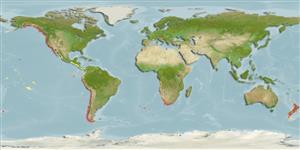
Southeast Atlantic and Eastern Pacific.
Length at first maturity / Size / Weight / Age
Maturity: Lm ? range ? - ? cm Max length : 17.5 cm WD male/unsexed; (Ref. 2992)
Usually found offshore in waters deeper than 150 m (Ref. 3292).
Life cycle and mating behavior
Maturity | Reproduction | Spawning | Eggs | Fecundity | Larvae
Members of the order Leptothecata include L-form hydroids. Life cycle: The zygote develops into planula and later into polyp then into free-swimming medusa.
Dawson, M.N. 2004 Some implications of molecular phylogenetics for understanding biodiversity in jellyfishes, with emphasis on Scyphozoa. Hydrobiologia 530/531:249-260. (Ref. 3017)
IUCN Red List Status
(Ref. 130435: Version 2025-2 (Global))
CITES status (Ref. 108899)
Not Evaluated
Not Evaluated
Threat to humans
Human uses
FAO - Publication: search | FishSource |
Tools
More information
Trophic EcologyFood items (preys)
Diet composition
Food consumption
Predators
Life cycleReproductionMaturityFecunditySpawningEggsEgg developmentLarvae PhysiologyOxygen consumption
Human RelatedStamps, coins, misc.
Internet sources
Estimates based on models
Resilience
(Ref. 69278): |
High, minimum population doubling time less than 15 months (K=0.87) |
Fishing Vulnerability
(Ref. 71543) |
Low vulnerability (10 of 100). |
Price category
(Ref. 80766): |
Unknown. |