Bivalvia |
Pectinida |
Pectinidae
Environment: milieu / climate zone / depth range / distribution range
Ecology
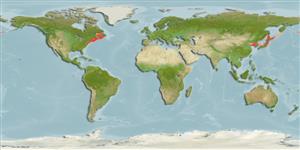
Benthic; depth range 0 - 300 m (Ref. 83435), usually 30 - 91 m (Ref. 83435). Temperate, preferred 9°C (Ref. 107945); 52°N - 35°N, 76°W - 51°W
Northwest Atlantic: Strait of Belle Isle, Canada to Georges Bank, south to Cape Hatteras, North Carolina, USA.
Length at first maturity / Size / Weight / Age
Maturity: Lm ? range ? - ? cm Max length : 20.0 cm TL male/unsexed; (Ref. 7726); max. reported age: 12 years (Ref. 8702)
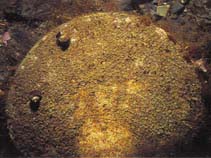
Large epibenthic bivalve found along the continental shelf (Ref. 121934). Semi-mobile. Opportunistic filter feeder, utilizing both pelagic and benthic organisms as food (Ref. 106925),
Life cycle and mating behavior
Maturity | Reproduction | Spawning | Eggs | Fecundity | Larvae
Members of the class Bivalvia are mostly gonochoric, some are protandric hermaphrodites. Life cycle: Embryos develop into free-swimming trocophore larvae, succeeded by the bivalve veliger, resembling a miniature clam.
Harvey-Clark, C. 1997 Eastern tidepool and reef: north-central Atlantic marinelife guide. Hancock House Publishers, 64pp. (Ref. 7726)
IUCN Red List Status
(Ref. 130435: Version 2025-2 (Global))
CITES status (Ref. 108899)
Not Evaluated
Not Evaluated
Threat to humans
Human uses
Fisheries: commercial
FAO - Fisheries: species profile, landings search; Publication: search | FishSource | Sea Around Us
Tools
More information
PhysiologyOxygen consumption
Human RelatedStamps, coins, misc.
Internet sources
Estimates based on models
Resilience
(Ref. 69278): |
Medium, minimum population doubling time 1.4 - 4.4 years (K=0.16-0.38; tmax=12) |
Rate of population increase
|
Prior r = 0.78, 95% CL = 0.51 - 1.17, Based on 2 full stock assessments. |
Fishing Vulnerability
(Ref. 71543) |
Moderate to high vulnerability (48 of 100). |
Climate Vulnerability
(Ref. 125649) |
High vulnerability (55 of 100) |
Price category
(Ref. 80766): |
Low. |
Nutrients
|
Calcium = 149 [71, 228] mg/100g; Iron = 8.53 [1.95, 15.11] mg/100g; Protein = 9.88 [8.64, 11.12] %; Omega3 = 0.313 [0.202, 0.423] g/100g; Selenium = 61 [50, 72] μg/100g; VitaminA = 0 μg/100g; Zinc = 2.04 [0.56, 3.51] mg/100g (wet weight); based on nutrient studies. |