-

- About this page
- Languages
-
Feedback
- Citation
- Upload
-
Related species
- Species in
Cymatium - Species in
Ranellidae - - Classification -
- Cymatiinae
- Ranellidae
- Littorinimorpha
- Gastropoda
- Chordata
- Animalia
- Species in
-



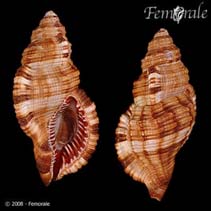
Cymatium pileare (Linnaeus, 1758)
Common hairy triton| Native range | All suitable habitat | Point map | Year 2050 |

|
| This map was computer-generated and has not yet been reviewed. |
| Cymatium pileare AquaMaps Data sources: GBIF OBIS |
Classification / Names Common names | Synonyms | CoL | ITIS | WoRMS
Gastropoda | Littorinimorpha | Ranellidae | Cymatiinae
Environment: milieu / climate zone / depth range / distribution range Ecology
Benthic; depth range 0 - 50 m (Ref. 349). Tropical
Distribution Countries | FAO areas | Ecosystems | Occurrences | Introductions
Indo-Pacific.
Length at first maturity / Size / Weight / Age
Maturity: Lm ? range ? - ? cm Max length : 14.0 cm ShH male/unsexed; (Ref. 349); common length : 9.0 cm SHL male/unsexed; (Ref. 349)
Locally collected for food (Ref. 349). Usually on hard and coarse detritic bottoms (Ref. 349). Commonly found on shallow coral reefs, particularly on patch reefs and reef flats. Also on seagrass beds (Ref. 69146).
Life cycle and mating behavior Maturity | Reproduction | Spawning | Eggs | Fecundity | Larvae
Members of the order Neotaenioglossa are mostly gonochoric and broadcast spawners. Life cycle: Embryos develop into planktonic trocophore larvae and later into juvenile veligers before becoming fully grown adults.
Main reference
References | Coordinator | Collaborators
Poutiers, J.M. 1998 Gastropods. p. 363-648. In Carpenter, K. E. and V. H. Niem. 1998. FAO species identification guide for fishery purposes. The living marine resources of the Western Central Pacific. Volume 1. Seaweeds, corals, bivalves, and gastropods. Rome, FAO. (Ref. 349)
IUCN Red List Status
(Ref. 130435: Version 2025-1)
CITES status (Ref. 108899)
Not Evaluated
CMS (Ref. 116361)
Not Evaluated
Threat to humans
Human uses
Fisheries: commercial
| FishSource |
Tools
More information
Trophic Ecology
Ecology
Population dynamics
Growth
Max. ages / sizes
Length-weight rel.
Length-length rel.
Length-frequencies
Mass conversion
Abundance
Max. ages / sizes
Length-weight rel.
Length-length rel.
Length-frequencies
Mass conversion
Abundance
Life cycle
Distribution
Physiology
Oxygen consumption
Human Related
Stamps, coins, misc.
Outreach
Taxonomy
References
Internet sources
BHL | BOLD Systems | CISTI | DiscoverLife | FAO(Publication : search) | Fishipedia | GenBank (genome, nucleotide) | GloBI | Gomexsi | Google Books | Google Scholar | Google | PubMed | Tree of Life | Wikipedia (Go, Search) | Zoological Record
Estimates based on models
Preferred temperature
(Ref. 115969): 24.2 - 29.1, mean 28.1 (based on 1296 cells).
Price category
(Ref. 80766):
Unknown.