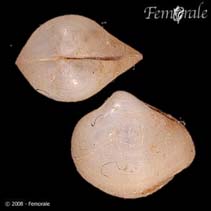
Bivalvia |
Not assigned |
Poromyidae
Environment: milieu / climate zone / depth range / distribution range
Ecology
Benthic; depth range 85 - 682 m (Ref. 83435). Polar; 83°N - 34°S, 84°W - 42°E
Atlantic Ocean, Mediterranean Sea and the Arctic: from Florida Keys, south to Rio Grande do Sul, north to Svalbard and east to White Sea. Polar to tropical.
Length at first maturity / Size / Weight / Age
Maturity: Lm ? range ? - ? cm Max length : 0.5 cm DL male/unsexed; (Ref. 83435)
Minimum depth from Ref. 104365.
Life cycle and mating behavior
Maturity | Reproduction | Spawning | Eggs | Fecundity | Larvae
Members of the class Bivalvia are mostly gonochoric, some are protandric hermaphrodites. Life cycle: Embryos develop into free-swimming trocophore larvae, succeeded by the bivalve veliger, resembling a miniature clam.
Zenetos, A., E. Vardala-Theodorou and C. Alexandrakis 2005 Update of the marine Bivalvia Mollusca checklist in Greek Waters. J. Mar. Biol. Ass. U.K. 85:993-998. (Ref. 2684)
IUCN Red List Status
(Ref. 130435: Version 2025-2 (Global))
CITES status (Ref. 108899)
Not Evaluated
Not Evaluated
Threat to humans
Human uses
FAO - Publication: search | FishSource |
Tools
More information
Trophic EcologyFood items (preys)
Diet composition
Food consumption
Predators
Population dynamicsGrowth
Max. ages / sizes
Length-weight rel.
Length-length rel.
Length-frequencies
Mass conversion
Abundance
Life cycleReproductionMaturityFecunditySpawningEggsEgg developmentLarvae PhysiologyOxygen consumption
Human RelatedStamps, coins, misc.
Internet sources
Estimates based on models
Fishing Vulnerability
(Ref. 71543) |
Low vulnerability (10 of 100). |
Price category
(Ref. 80766): |
Unknown. |