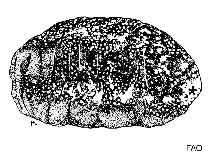
Holothuroidea |
Holothuriida |
Holothuriidae
Environment: milieu / climate zone / depth range / distribution range
Ecology
Benthic; depth range 0 - 2 m (Ref. 111335). Tropical; 31°N - 8°N, 98°W - 58°W
Western Central Atlantic: Belize.
Length at first maturity / Size / Weight / Age
Maturity: Lm ? range ? - ? cm Max length : 51.0 cm TL male/unsexed; (Ref. 702)
Found on mangrove swamp and beach shoreline (Ref. 111335).
Life cycle and mating behavior
Maturity | Reproduction | Spawning | Eggs | Fecundity | Larvae
Members of the class Holothuroidea are gonochoric and have only one gonad. Spawning and fertilization are both external and some exhibit brooding. Life cycle: Embryos develop into planktotrophic larvae (auricularia) then into doliolaria (barrel-shaped stage) which later metamorphose into juvenile sea cucumbers.
Hendler, G. and D.L. Pawson 2000 Echinoderms of the Rhomboidal Cays, Belize: Biodiversity, distribution, and ecology. Atoll Research Bulletin 479:275-299. (Ref. 86570)
IUCN Red List Status
(Ref. 130435: Version 2025-2 (Global))
CITES status (Ref. 108899)
Not Evaluated
Not Evaluated
Threat to humans
Human uses
Fisheries: commercial
FAO - Publication: search | FishSource |
Tools
More information
Trophic EcologyFood items (preys)
Diet composition
Food consumption
Predators
Life cycleReproductionMaturityFecunditySpawningEggsEgg developmentLarvae PhysiologyOxygen consumption
Human RelatedStamps, coins, misc.
Internet sources
Estimates based on models
Resilience
(Ref. 69278): |
Medium, minimum population doubling time 1.4 - 4.4 years (K=0.21) |
Fishing Vulnerability
(Ref. 71543) |
Moderate vulnerability (36 of 100). |
Price category
(Ref. 80766): |
Unknown. |