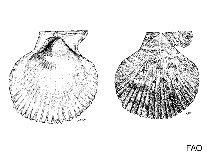
Bivalvia |
Pectinida |
Pectinidae
Environment: milieu / climate zone / depth range / distribution range
Ecology
Benthic; depth range 5 - 170 m (Ref. 114137). Subtropical, preferred 17°C (Ref. 107945); 35°S - 47°S, 46°W - 176°W
Southwest Pacific: Endemic to New Zealand, from Kawau Island down to Stewart Island and east to Chatham Island.
Length at first maturity / Size / Weight / Age
Maturity: Lm 6.0, range 5 - 5.9 cm Max length : 14.0 cm ShL male/unsexed; (Ref. )
Minimum depth range from Ref. 114139. Found in soft sediments. Juveniles are preyed upon by sea stars, gastropods, octopus, snapper, and large rays (Ref. 1244). Feeds on phytoplankton (Ref. 114780).
Life cycle and mating behavior
Maturity | Reproduction | Spawning | Eggs | Fecundity | Larvae
Members of the class Bivalvia are mostly gonochoric, some are protandric hermaphrodites. Life cycle: Embryos develop into free-swimming trocophore larvae, succeeded by the bivalve veliger, resembling a miniature clam.
SAUP Database 2006 SAUP Database. www.seaaroundus.org. (Ref. 356)
IUCN Red List Status
(Ref. 130435: Version 2025-2 (Global))
CITES status (Ref. 108899)
Not Evaluated
Not Evaluated
Threat to humans
Human uses
Fisheries: commercial
FAO - Fisheries: landings search; Publication: search | FishSource | Sea Around Us
Tools
More information
Population dynamicsGrowthMax. ages / sizesLength-weight rel.Length-length rel.Length-frequenciesMass conversionAbundance PhysiologyOxygen consumption
Human RelatedStamps, coins, misc.
Internet sources
Estimates based on models
Resilience
(Ref. 69278): |
High, minimum population doubling time less than 15 months (K=0.58) |
Rate of population increase
|
Prior r = 0.51, 95% CL = 0.34 - 0.76, Based on 5 data-limited stock assessments. |
Fishing Vulnerability
(Ref. 71543) |
Low vulnerability (22 of 100). |
Climate Vulnerability
(Ref. 125649) |
High vulnerability (64 of 100) |
Price category
(Ref. 80766): |
High. |
Nutrients
|
Calcium = 149 [71, 228] mg/100g; Iron = 8.53 [1.95, 15.11] mg/100g; Protein = 9.88 [8.64, 11.12] %; Omega3 = 0.313 [0.202, 0.423] g/100g; Selenium = 61 [50, 72] μg/100g; VitaminA = 0 μg/100g; Zinc = 2.04 [0.56, 3.51] mg/100g (wet weight); based on nutrient studies. |