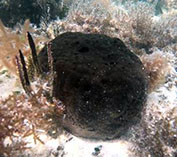
Demospongiae |
Dictyoceratida |
Spongiidae
Environment: milieu / climate zone / depth range / distribution range
Ecology
Sessile; non-migratory; depth range 5 - 15 m (Ref. 108813). Tropical; 28°N - 8°N, 89°W - 113°E
Indo-West Pacific and Western Central Atlantic: from Belize north to Bahamas, south to Tamil Nadu India and east to China.
Length at first maturity / Size / Weight / Age
Maturity: Lm ? range ? - ? cm Max length : 28.7 cm OT male/unsexed; (Ref. 125998); max. reported age: 16 years (Ref. 125998)
Minimum depth from Ref. 125927. Maximum length = diameter (Rref. 125998).
Life cycle and mating behavior
Maturity | Reproduction | Spawning | Eggs | Fecundity | Larvae
Members of the class Demospongiae are hermaphroditic. Life cycle: The zygote develops into parenchymella larva (free-swimming) before settling down on a substrate where it grows into a young sponge.
Engel, S. and J.R. Pawlik 2005 Interactions among Florida sponges. I. Reef habitats. Mar. Ecol. Prog. Ser. 303:133-144. (Ref. 837)
IUCN Red List Status
(Ref. 130435: Version 2025-2 (Global))
CITES status (Ref. 108899)
Not Evaluated
Not Evaluated
Threat to humans
Human uses
Fisheries: commercial; aquaculture: commercial
FAO - Publication: search | FishSource |
Tools
More information
Trophic EcologyFood items (preys)
Diet composition
Food consumption
Predators
Life cycleReproductionMaturityFecunditySpawningEggsEgg developmentLarvae PhysiologyOxygen consumption
Human RelatedStamps, coins, misc.
Internet sources
Estimates based on models
Resilience
(Ref. 69278): |
Medium, minimum population doubling time 1.4 - 4.4 years (K=0.19; tmax=16) |
Fishing Vulnerability
(Ref. 71543) |
Moderate vulnerability (45 of 100). |
Price category
(Ref. 80766): |
Unknown. |