Cephalopoda |
Octopoda |
Octopodidae
Entorno: milieu / zona climática / rango de profundidad / gama de distribución
Ecología
Benthic; rango de profundidad 0 - 37 m (Referencia 96968). Tropical
Indo-West Pacific.
Longitud en la primera madurez / Tamaño / Peso / Edad
Madurez: Lm ? range ? - ? cm Max length : 48.0 cm TL macho / no sexado; (Referencia 96968)
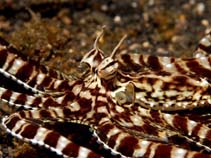
Mantle length is 5.8 cm. Species is known for its mimicry of toxic models that co-occur in the same habitat, namely banded soles, sea snakes, and lionfish, with other distinct postures and behaviors currently being open to interpretation (Ref. 96968). This octopus often occupies the vacated burrows of other animals. These lairs appear temporary or may form a network of regular lairs within a home range. Individuals were observed to occupy a particular hole for periods of between one to four days. Some individuals were observed to leave one hole at first light, forage throughout the day (including entering and exiting from various animal burrows throughout the day) and remain overnight within the last hole encountered during foraging bouts. These animals were observed to emerge from the same hole at first light the next day (Ref. 96968). Active during the day. Feeds on crustaceans and fishes (Ref. 7940).
Ciclo vital y comportamiento de apareamiento
Madurez | Reproducción | Puesta | Huevos | Fecundidad | Larva
Members of the class Cephalopoda are gonochoric. Male and female adults usually die shortly after spawning and brooding, respectively. Mating behavior: Males perform various displays to attract potential females for copulation. During copulation, male grasp the female and inserts the hectocotylus into the female's mantle cavity where fertilization usually occurs. Life cycle: Embryos hatch into planktonic stage and live for some time before they grow larger and take up a benthic existence as adults.
Norman, M.D. and F.G. Hochberg 2005 The "mimic octopus" (Thaumoctopus mimicus n. gen. et sp.), a new octopus from the tropical Indo-west Pacific (Cephalopoda: Octopodidae). Molluscan Research 25(2):57-70. (Referencia 7940)
Situación en la Lista Roja de la UICN
(Referencia 130435: Version 2025-2 (Global))
Estatus CITES (Referencia 108899)
Not Evaluated
CMS (Referencia 116361)
Not Evaluated
Amenaza para el ser humano
Harmless
Usos humanos
FAO - Publication: search | FishSource |
Herramientas
Más información
Dinámica de la poblaciónCrecimiento
Edades / tallas máximas
Longitud-peso rel.
Longitud-longitud rel.
Longitud-frecuencias
Conversión de masas
Abundancia
Ciclo de vidaReproducciónMadurezFecundidadPuestaHuevosDesarrollo de los huevosLarva FisiologíaConsumo del oxígeno
Relacionados con el ser humanoSellos, monedas, varios
Fuentes de Internet
Estimaciones basadas en modelos
Vulnerabilidad pesquera
(Referencia 71543) |
Moderate vulnerability (38 of 100). |