Bivalvia |
Pectinida |
Pectinidae
Umwelt: Milieu / Klimazone / Tiefenbereich / Verbreitungsgebiet
Ökologie
Benthic; tiefenbereich 0 - 610 m (Ref. 89006). Temperate
Indo-West Pacific: from East Africa, including Madagascar, to Melanesia; north to the Philippines and south to Queensland, New Caledonia and New Zealand.
Länge bei der ersten Reifung / Größe / Gewicht / Alter
Geschlechtsreife: Lm ? range ? - ? cm Max length : 8.0 cm SHH Männchen/unbestimmt; (Ref. 348); common length : 6.0 cm SHH Männchen/unbestimmt; (Ref. 348)
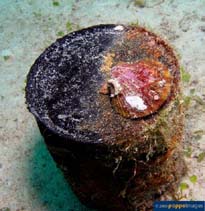
Shell solid, medium sized, higher than long and rounded-ovate in outline. Both valves convex and subequal, the right (lower) valve a little flatter than the left (upper) valve. Ears markedly unequal in size, the anterior ones more than twice the length of the posterior ones. Ventral side of right anterior ear with a deep byssal notch and a ctenolium. Main sculpture of each valve of 20 to 26 rounded often with fine secondary radial threads, and with microscopic lines, obliquely diverging on anterior and posterior sides of valves. Ears strongly ribbed, the dorsalmost rib of right anterior ear somewhat protruding and adorned with erect spines. Interior shiny, with low, rounded radial ribs corresponding to the outer sculpture. Colour: outside of shell variable, dull purple, brown or orange, frequently variegated with paler blotches. Interior similarly coloured, suffused with white on hinge and umbonal cavity.
On sandy or muddy-sand bottoms with gravel, coral rubble, shell debris or rocks. Attached by its byssus to hard elements, even in adult stages (Ref. 8121); specifically adheres to corals or rocks among coral rubble on soft sediments (Ref. 101147). Abundant in sandy-coralline areas (Ref. 128042). Living in shallow waters (Ref. 101147) at 37 m to 71 m water depth (Ref. 89006).
Lebenszyklus und Paarungsverhalten
Geschlechtsreife | Fortpflanzung | Ablaichen | Eier | Fruchtbarkeit | Larven
Members of the class Bivalvia are mostly gonochoric, some are protandric hermaphrodites. Life cycle: Embryos develop into free-swimming trocophore larvae, succeeded by the bivalve veliger, resembling a miniature clam.
Spurgeon, A. 2007 New Zealand Mollusca. http://www.mollusca.co.nz/index.php (Ref. 8121)
IUCN Rote Liste Status
(Ref. 130435: Version 2025-2 (Global))
CITES Status (Ref. 108899)
Not Evaluated
Not Evaluated
Bedrohung für Menschen
Nutzung durch Menschen
Fischereien: kommerziell
FAO - Publication: search | FishSource | Das Meer um uns herum
Tools
Mehr Information
LebenszyklusFortpflanzungGeschlechtsreifeFruchtbarkeitAblaichenEierEientwicklungLarven PhysiologieSauerstoffverbrauch
MenschenbezogenBriefmarken, Münzen, Verschiedenes.
Internet Quellen
Schätzungen auf der Grundlage von Modellen
Widerstandsfähigkeit
(Ref. 69278): |
hoch, Verdopplung der Population dauert weniger als 15 Monate. (K=0.46-0.65) |
Anfälligkeit der Fischerei
(Ref. 71543) |
Low to moderate vulnerability (29 of 100). |
Preiskategorie
(Ref. 80766): |
Medium. |