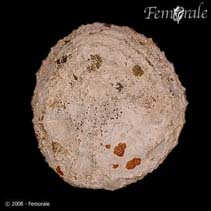
Gastropoda |
Not assigned |
Patellidae
Environnement : milieu / zone climatique / profondeur / gamme de distribution
Écologie
Benthic; profondeur 0 - 3 m (Réf. 106682). Subtropical; 29°S - 33°S, 179°W - 176°W
Southwest Pacific: Endemic to Kermadec Island.
Longueur à la première maturité / Taille / Poids / Âge
Maturité: Lm ? range ? - ? cm
Found from intertidal to immediate subtidal, on rock (Ref. 337). Lives on the upper surface of the rocks and abundant from just above low-water mark down to 2 m or 3 m in Sunday Island, and the shells are covered with coralline and other algae, together with Siphonaria, Elminius, and their youngs (Ref. 88739). Individuals are usually found in homing scars amongst turf algae (Ref. 89427).
Cycle de vie et comportement reproducteur
Maturité | Reproduction | Frai | Œufs | Fécondité | Larves
Members of the order Archaeogastropoda are mostly gonochoric and broadcast spawners. Life cycle: Embryos develop into planktonic trocophore larvae and later into juvenile veligers before becoming fully grown adults.
Brook, F.J. 1998 The coastal molluscan fauna of the northern Kermadec Islands, Southwest Pacific Ocean. Journal of the Royal Society of New Zealand 28(2):185-233. (Réf. 337)
Statut dans la liste rouge de l'IUCN
(Réf. 130435: Version 2025-2 (Global))
statut CITES (Réf. 108899)
Not Evaluated
Not Evaluated
Menace pour l'homme
Harmless
Utilisations par l'homme
FAO - Publication: search | FishSource |
Outils
Plus d'informations
Écologie trophiqueAliments (proies)
Composition du régime alimentaire
Consommation alimentaire
Prédateurs
Dynamique des populationsCroissanceÂges / tailles maximalesLongueur-poids rel.Rel. longueur-longueur.Fréquences de longueursConversion de masseAbondance Cycle de vieReproductionMaturitéFéconditéFraiŒufsDéveloppement de l'œufLarves PhysiologieConsommation d'oxygène
Liées à l'hommeTimbres, pièces de monnaie, divers
Sources Internet
Estimations basées sur des modèles
Vulnérabilité de la pêche
(Réf. 71543) |
(0 of 100). |