Phaeophyceae |
Dictyotales |
Dictyotaceae
Environnement : milieu / zone climatique / profondeur / gamme de distribution
Écologie
Epiphytic. Tropical
Atlantic Ocean: In Bermuda going to the Caribbean and south to Venezuela; Indian Ocean: In Kwazulu-Natal, South Africa; Pacific Ocean: In Micronesia, south to Solomon Islands, east to French Polynesia including American Samoa, and south to Tahiti.
Longueur à la première maturité / Taille / Poids / Âge
Maturité: Lm ? range ? - ? cm Max length : 3.0 cm TL mâle / non sexé; (Réf. 82093)
Description synthétique
Morphologie
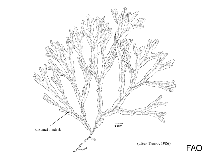
The thallus is repent, up to 3 cm, attached to hosts at various points by patches of rhizoids. The straps, 1-2 mm wide, are dichotomously branched. The margins are smooth except for the falcate branchlets, which may resemble teeth. The surface is smooth. The apices are rounded to tridentate. The medulla and cortex are uniformly one layered. Sporangia or gametangia were not observed (Ref. 82093).
Dictyota hamifera is easily recognized by its falcate, swollen branchlets (Ref. 82093). Specimens were collected at a depth of 18 to 25 m epiphytic on Plocamium sp. (Ref. 82093)
Cycle de vie et comportement reproducteur
Maturité | Reproduction | Frai | Œufs | Fécondité | Larves
Guiry, M.D. and G.M. Guiry 2009 AlgaeBase. World-wide electronic publication, National University of Ireland, Galway. http://www.algaebase.org; searched on 14 April 2009. (Réf. 80701)
Statut dans la liste rouge de l'IUCN
(Réf. 130435: Version 2025-2 (Global))
statut CITES (Réf. 108899)
Not Evaluated
Not Evaluated
Menace pour l'homme
Utilisations par l'homme
FAO - Publication: search | FishSource |
Outils
Plus d'informations
Écologie trophiqueAliments (proies)
Composition du régime alimentaire
Consommation alimentaire
Prédateurs
Dynamique des populationsCroissanceÂges / tailles maximalesLongueur-poids rel.Rel. longueur-longueur.Fréquences de longueursConversion de masseAbondance Cycle de vieReproductionMaturitéFéconditéFraiŒufsDéveloppement de l'œufLarves PhysiologieConsommation d'oxygène
Liées à l'hommeTimbres, pièces de monnaie, divers
Sources Internet
Estimations basées sur des modèles
Vulnérabilité de la pêche
(Réf. 71543) |
Low vulnerability (10 of 100). |