Phaeophyceae |
Dictyotales |
Dictyotaceae
Umwelt: Milieu / Klimazone / Tiefenbereich / Verbreitungsgebiet
Ökologie
Epiphytic. Tropical
Atlantic Ocean: In Bermuda going to the Caribbean and south to Venezuela; Indian Ocean: In Kwazulu-Natal, South Africa; Pacific Ocean: In Micronesia, south to Solomon Islands, east to French Polynesia including American Samoa, and south to Tahiti.
Länge bei der ersten Reifung / Größe / Gewicht / Alter
Geschlechtsreife: Lm ? range ? - ? cm Max length : 3.0 cm TL Männchen/unbestimmt; (Ref. 82093)
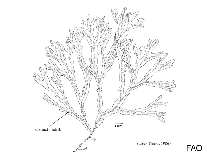
The thallus is repent, up to 3 cm, attached to hosts at various points by patches of rhizoids. The straps, 1-2 mm wide, are dichotomously branched. The margins are smooth except for the falcate branchlets, which may resemble teeth. The surface is smooth. The apices are rounded to tridentate. The medulla and cortex are uniformly one layered. Sporangia or gametangia were not observed (Ref. 82093).
Dictyota hamifera is easily recognized by its falcate, swollen branchlets (Ref. 82093). Specimens were collected at a depth of 18 to 25 m epiphytic on Plocamium sp. (Ref. 82093)
Lebenszyklus und Paarungsverhalten
Geschlechtsreife | Fortpflanzung | Ablaichen | Eier | Fruchtbarkeit | Larven
Guiry, M.D. and G.M. Guiry 2009 AlgaeBase. World-wide electronic publication, National University of Ireland, Galway. http://www.algaebase.org; searched on 14 April 2009. (Ref. 80701)
IUCN Rote Liste Status
(Ref. 130435: Version 2025-2 (Global))
CITES Status (Ref. 108899)
Not Evaluated
Not Evaluated
Bedrohung für Menschen
Nutzung durch Menschen
FAO - Publication: search | FishSource |
Tools
Mehr Information
Trophische ÖkologieLebensmittel (Beutetiere)
Nahrungszusammensetzung
Nahrungsaufnahme
Räuber
PopulationsdynamikWachstumMax. Alter/GrößenLänge-Gewicht-Rel.Länge-Länge-Verhältnis.LängenhäufigkeitenMassenkonvertierungDichte LebenszyklusFortpflanzungGeschlechtsreifeFruchtbarkeitAblaichenEierEientwicklungLarven PhysiologieSauerstoffverbrauch
MenschenbezogenBriefmarken, Münzen, Verschiedenes.
Internet Quellen
Schätzungen auf der Grundlage von Modellen
Anfälligkeit der Fischerei
(Ref. 71543) |
Low vulnerability (10 of 100). |