Gastropoda |
Ellobiida |
Ellobiidae
Environnement : milieu / zone climatique / profondeur / gamme de distribution
Écologie
Benthic. Tropical
Indo-West Pacific.
Longueur à la première maturité / Taille / Poids / Âge
Maturité: Lm ? range ? - ? cm Max length : 6.0 cm ShH mâle / non sexé; (Réf. 349); common length : 5.0 cm SHL mâle / non sexé; (Réf. 349)
Description synthétique
Morphologie
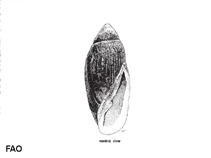
Shell medium sized, solid, elongateovate in outline, not shouldered. Spire apex blunt, often corroded in mature specimens. Sculpture of numerous axial grooves and fine spiral lines, causing a finely latticed pattern throughout the surface of shell, though it is somewhat stronger on posterior half of body whorl than on anterior half. Periostracum tough, closely applied to shell. Outer lip of the aperture thick and smooth inside, with a low swelling at about the middle. Inner lip glazed, with 3 folds; posterior fold tooth-like, centre fold oblique, large and angular, anterior fold weak and almost axial in direction. Colour: outside of shell whitish under the dark brown periostracum. Aperture porcelaneous white.
Found at mangrove swamps, Nipa palm forests and mud flats near the coast (Ref. 349). An epifaunal deposit feeder (Ref. 129221).
Cycle de vie et comportement reproducteur
Maturité | Reproduction | Frai | Œufs | Fécondité | Larves
Members of the order Pulmonata are mostly simultaneous hermaphrodites.
Poutiers, J.M. 1998 Gastropods. p. 363-648. In Carpenter, K. E. and V. H. Niem. 1998. FAO species identification guide for fishery purposes. The living marine resources of the Western Central Pacific. Volume 1. Seaweeds, corals, bivalves, and gastropods. Rome, FAO. (Réf. 349)
Statut dans la liste rouge de l'IUCN
(Réf. 130435: Version 2025-2 (Global))
statut CITES (Réf. 108899)
Not Evaluated
Not Evaluated
Menace pour l'homme
Utilisations par l'homme
Pêcheries: pêcheries vivrières
FAO - Publication: search | FishSource |
Outils
Plus d'informations
Écologie trophiqueAliments (proies)
Composition du régime alimentaire
Consommation alimentaire
Prédateurs
Dynamique des populationsCroissanceÂges / tailles maximalesLongueur-poids rel.Rel. longueur-longueur.Fréquences de longueursConversion de masseAbondance Cycle de vieReproductionMaturitéFéconditéFraiŒufsDéveloppement de l'œufLarves PhysiologieConsommation d'oxygène
Liées à l'hommeTimbres, pièces de monnaie, divers
Sources Internet
Estimations basées sur des modèles
Vulnérabilité de la pêche
(Réf. 71543) |
Low vulnerability (10 of 100). |
Catégorie de prix
(Réf. 80766): |
Unknown. |