Gastropoda |
Ellobiida |
Ellobiidae
Umwelt: Milieu / Klimazone / Tiefenbereich / Verbreitungsgebiet
Ökologie
Benthic. Tropical
Indo-West Pacific.
Länge bei der ersten Reifung / Größe / Gewicht / Alter
Geschlechtsreife: Lm ? range ? - ? cm Max length : 6.0 cm ShH Männchen/unbestimmt; (Ref. 349); common length : 5.0 cm SHL Männchen/unbestimmt; (Ref. 349)
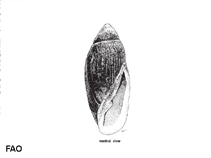
Shell medium sized, solid, elongateovate in outline, not shouldered. Spire apex blunt, often corroded in mature specimens. Sculpture of numerous axial grooves and fine spiral lines, causing a finely latticed pattern throughout the surface of shell, though it is somewhat stronger on posterior half of body whorl than on anterior half. Periostracum tough, closely applied to shell. Outer lip of the aperture thick and smooth inside, with a low swelling at about the middle. Inner lip glazed, with 3 folds; posterior fold tooth-like, centre fold oblique, large and angular, anterior fold weak and almost axial in direction. Colour: outside of shell whitish under the dark brown periostracum. Aperture porcelaneous white.
Found at mangrove swamps, Nipa palm forests and mud flats near the coast (Ref. 349). An epifaunal deposit feeder (Ref. 129221).
Lebenszyklus und Paarungsverhalten
Geschlechtsreife | Fortpflanzung | Ablaichen | Eier | Fruchtbarkeit | Larven
Members of the order Pulmonata are mostly simultaneous hermaphrodites.
Poutiers, J.M. 1998 Gastropods. p. 363-648. In Carpenter, K. E. and V. H. Niem. 1998. FAO species identification guide for fishery purposes. The living marine resources of the Western Central Pacific. Volume 1. Seaweeds, corals, bivalves, and gastropods. Rome, FAO. (Ref. 349)
IUCN Rote Liste Status
(Ref. 130435: Version 2025-2 (Global))
CITES Status (Ref. 108899)
Not Evaluated
Not Evaluated
Bedrohung für Menschen
Nutzung durch Menschen
Fischereien: kleinfischerei
FAO - Publication: search | FishSource |
Tools
Mehr Information
Trophische ÖkologieLebensmittel (Beutetiere)
Nahrungszusammensetzung
Nahrungsaufnahme
Räuber
PopulationsdynamikWachstumMax. Alter/GrößenLänge-Gewicht-Rel.Länge-Länge-Verhältnis.LängenhäufigkeitenMassenkonvertierungDichte LebenszyklusFortpflanzungGeschlechtsreifeFruchtbarkeitAblaichenEierEientwicklungLarven PhysiologieSauerstoffverbrauch
MenschenbezogenBriefmarken, Münzen, Verschiedenes.
Internet Quellen
Schätzungen auf der Grundlage von Modellen
Anfälligkeit der Fischerei
(Ref. 71543) |
Low vulnerability (10 of 100). |
Preiskategorie
(Ref. 80766): |
Unknown. |