Malacostraca |
Decapoda |
Portunidae
Umwelt: Milieu / Klimazone / Tiefenbereich / Verbreitungsgebiet
Ökologie
Benthic; tiefenbereich 0 - 65 m (Ref. 106819). Tropical
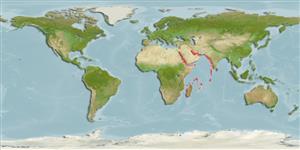
Western Indian Ocean: From Pakistan westwards to the Arabian Gulf extending to the east African coast to South Africa and to Madagascar and Mauritius. Introduced in the Mediterranean through the Suez Canal and established up to the northern Tyrrhenian Sea.
Länge bei der ersten Reifung / Größe / Gewicht / Alter
Geschlechtsreife: Lm 7.4 range ? - ? cm Max length : 16.2 cm CW Männchen/unbestimmt; (Ref. 115276); 16.2 cm CW (female)
Lives mainly in coastal waters in seagrass meadows and along mangroves (Ref. 115276), and intertidal mudflats (Ref. 128960). Found under rocks and in rock pools, on sandy or muddy substrate (Ref. 111207). Larger biomass is seen between depths of 2 to 15 m. Small juveniles are found in very shallow waters (less than 1 m); females occupy deep-water zones during spawning (Ref. 115276). Opportunistic predator, primarily a carnivore preying on a variety of benthic animals and less marine plants and seagrass (Ref. 108412). Prolific predators of bivalves. Some suggested that they're opportunistic omnivores or detritivores, feeding on carrion, especially on fishing-discards. Efficient night time forager, using a characteristic zigzag search pattern to locate prey (Ref. 115276).
Lebenszyklus und Paarungsverhalten
Geschlechtsreife | Fortpflanzung | Ablaichen | Eier | Fruchtbarkeit | Larven
Safaie, M., J. Pazooki, B. Kiabi and M.R. Shokri 2013 Reproductive biology of blue swimming crab, Portunus segnis (Forskal, 1775) in coastal waters of Persian Gulf and Oman Sea, Iran. Iranian Journal of Fisheries Science 12(2):430-444. (Ref. 107016)
IUCN Rote Liste Status
(Ref. 130435: Version 2025-2 (Global))
CITES Status (Ref. 108899)
Not Evaluated
Not Evaluated
Bedrohung für Menschen
Harmless
Nutzung durch Menschen
FAO - Publication: search | FishSource |
Tools
Mehr Information
PhysiologieSauerstoffverbrauch
MenschenbezogenBriefmarken, Münzen, Verschiedenes.
Internet Quellen
Schätzungen auf der Grundlage von Modellen
Widerstandsfähigkeit
(Ref. 69278): |
hoch, Verdopplung der Population dauert weniger als 15 Monate. (K=1.6-1.7) |
Anfälligkeit der Fischerei
(Ref. 71543) |
Low vulnerability (10 of 100). |