Malacostraca |
Decapoda |
Geryonidae
محیط زیست: محیط زیست / منطقه آب و هوایی / تغييرات عمق / محدوده توزیع
بوم شناسي
Benthic; تغييرات عمق 130 - 2047 m (مرجع 2704), usually 200 - 2000 m (مرجع 78375). Deep-water; 64°N - 33°S, 81°W - 7°E (مرجع 2747)
Southeast Pacific and north Atlantic.
طول در اولین بلوغ / اندازه / وزن / سن
بلوغ: Lm ?, range 8 - 9.926 cm Max length : 15.5 cm CL جنس نر / بدون خواص جنسي; (مرجع 101417); 17.7 cm CL (female); بيشينه وزن گزارش شده: 863.00 g (مرجع 2720)
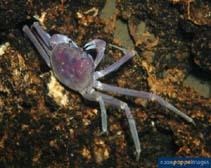
Maximum length for females from Ref. 2747. This is the largest epibenthic brachyuran crab of the Family Geryonidae (Ref. 2689). Bimodal length frequency for males and unimodal for females. More males and larger individuals in shallower substratum and increasing number of females and smaller individuals in deeper substratum (Ref. 2677, 2747). This is also a target species of gillnet operators in Northeast Atlantic fisheries (Ref. 2740). Inhabits a variety of bottom substrates from mud to rock (Ref. 2708, 2725 and 2747); at a depth of 700 m and deeper; it prefers soft substrata (Ref. 2753), and it is found on seamount and escarpments (Ref. 2740). Recruitment of individuals occurs in the deepest substrata. Sacculina sp. is parasitic on this species, infecting individuals in deeper substratum around 1000 to 1100 m (Ref. 2677). Males parasitized by Sacculina sp. are feminized behaviorally and morphologically (Ref. 2694), whereas females are castrated (Ref. 2696). Epibionts Poecilasma crassa and Poecilasma aurantia are found on the exoskeleton of the crab (Ref. 2747 and 2752). This is an allopatric species (Ref. 2763).
چرخه زندگی و رفتار جفتگیری
بلوغ | تولید مثل | تخم ریزی | تخم ها | باروری | توزاد ( لارو)
Inferred from the gonadosomatic index (GDI), presence of ovigerous females and evolution of the maturity stages, occurs in autumn and winter. This supports an annual reproductive cycle. Sexual maturity with carapace lengths from 7.3 to 9.7 cm (Ref. 2747, 2751).
مآخذ اصلی
مراجع | هماهنگ كننده | همكاران
Abellán, L.J.L., E. Balguerías and V. Fernández-Vergaz 2002 Life history characteristics of the deep-sea crab Chaceon affinis population off Tenerife (Canary Islands). Fish. Res. 58(2):231-239. (مرجع 2677)
وضعيت در فهرست قرمز IUCN
(مرجع 130435: Version 2025-2 (Global))
وضعيت از نظر سايتس (مرجع 108899)
Not Evaluated
Not Evaluated
خطر برای انسان ها
استفاده انسانی
ماهي گيري – شيلات: تجاري
FAO - Publication: search | FishSource | دریای اطراف ما
ابزارها
اطلاعات بيشتر
بومشناسی گرمسیریاقلام غذایی (طعمهها)
تركيب غذايي
مصرف غذايي
شکارچیان
مرتبط با انسانتمبر، سکه، متفرقه.
منابع اينترنتي
تخمینها بر اساس مدلها
آسیبپذیری ماهیگیری
(مرجع 71543) |
Low vulnerability (10 of 100). |
طبقه قيمت
(مرجع 80766): |
Unknown. |
Nutrients
|
Calcium = 109 [35, 184] mg/100g; Iron = 1.59 [1.21, 1.97] mg/100g; Protein = 20.2 [19.2, 21.3] %; Omega3 = 0.285 [0.185, 0.386] g/100g; Selenium = 48.3 [-31.7, 128.3] μg/100g; VitaminA = 0 μg/100g; Zinc = 1.79 [1.17, 2.40] mg/100g (wet weight); based on nutrient studies. |