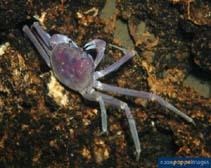
Malacostraca |
Decapoda |
Geryonidae
Umwelt: Milieu / Klimazone / Tiefenbereich / Verbreitungsgebiet
Ökologie
Benthic; tiefenbereich 130 - 2047 m (Ref. 2704), usually 200 - 2000 m (Ref. 78375). Deep-water; 64°N - 33°S, 81°W - 7°E (Ref. 2747)
Southeast Pacific and north Atlantic.
Länge bei der ersten Reifung / Größe / Gewicht / Alter
Geschlechtsreife: Lm ?, range 8 - 9.926 cm Max length : 15.5 cm CL Männchen/unbestimmt; (Ref. 101417); 17.7 cm CL (female); max. veröff. Gewicht: 863.00 g (Ref. 2720)
Maximum length for females from Ref. 2747. This is the largest epibenthic brachyuran crab of the Family Geryonidae (Ref. 2689). Bimodal length frequency for males and unimodal for females. More males and larger individuals in shallower substratum and increasing number of females and smaller individuals in deeper substratum (Ref. 2677, 2747). This is also a target species of gillnet operators in Northeast Atlantic fisheries (Ref. 2740). Inhabits a variety of bottom substrates from mud to rock (Ref. 2708, 2725 and 2747); at a depth of 700 m and deeper; it prefers soft substrata (Ref. 2753), and it is found on seamount and escarpments (Ref. 2740). Recruitment of individuals occurs in the deepest substrata. Sacculina sp. is parasitic on this species, infecting individuals in deeper substratum around 1000 to 1100 m (Ref. 2677). Males parasitized by Sacculina sp. are feminized behaviorally and morphologically (Ref. 2694), whereas females are castrated (Ref. 2696). Epibionts Poecilasma crassa and Poecilasma aurantia are found on the exoskeleton of the crab (Ref. 2747 and 2752). This is an allopatric species (Ref. 2763).
Inferred from the gonadosomatic index (GDI), presence of ovigerous females and evolution of the maturity stages, occurs in autumn and winter. This supports an annual reproductive cycle. Sexual maturity with carapace lengths from 7.3 to 9.7 cm (Ref. 2747, 2751).
Abellán, L.J.L., E. Balguerías and V. Fernández-Vergaz 2002 Life history characteristics of the deep-sea crab Chaceon affinis population off Tenerife (Canary Islands). Fish. Res. 58(2):231-239. (Ref. 2677)
IUCN Rote Liste Status
(Ref. 130435: Version 2025-2 (Global))
CITES Status (Ref. 108899)
Not Evaluated
Not Evaluated
Bedrohung für Menschen
Nutzung durch Menschen
Fischereien: kommerziell
FAO - Publication: search | FishSource | Das Meer um uns herum
Tools
Mehr Information
Trophische ÖkologieLebensmittel (Beutetiere)
Nahrungszusammensetzung
Nahrungsaufnahme
Räuber
PhysiologieSauerstoffverbrauch
MenschenbezogenBriefmarken, Münzen, Verschiedenes.
Internet Quellen
Schätzungen auf der Grundlage von Modellen
Anfälligkeit der Fischerei
(Ref. 71543) |
Low vulnerability (10 of 100). |
Preiskategorie
(Ref. 80766): |
Unknown. |
Nutrients
|
Calcium = 109 [35, 184] mg/100g; Iron = 1.59 [1.21, 1.97] mg/100g; Protein = 20.2 [19.2, 21.3] %; Omega3 = 0.285 [0.185, 0.386] g/100g; Selenium = 48.3 [-31.7, 128.3] μg/100g; VitaminA = 0 μg/100g; Zinc = 1.79 [1.17, 2.40] mg/100g (wet weight); based on nutrient studies. |