Malacostraca |
Decapoda |
Geryonidae
Miljö: miljö / Klimatzon / djupintervall / distributionsområde
Ekologi
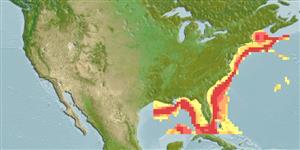
Benthic; djupintervall 0 - 2243 m (Ref. 104446). Temperate, preferred 22°C (Ref. 107945); 44°N - 23°N, 94°W - 62°W
Western Atlantic: From Emerald Bank, Nova Scotia, Canada, and the Gulf of Maine to the Mid-Atlantic Bight and the Gulf of Mexico.
Längd vid första mognad / Storlek / Vikt / Ålder
Könsmognad: Lm ?, range 7 - 9.1 cm Max length : 18.0 cm CW hane/ej könsbestämd; (Ref. 96186); 13.6 cm CW (female)
The larvae of this species may remain planktonic for up to 4 months before settlement depending on water temperature (Ref. 2763). Found along the continental shelf edge and slope. Associated with smooth or dimpled, unconsolidated and consolidated silt-clay sediments. Also occurs in canyon community (Ref. 96189). Displays deep-to-shallow migration as crabs mature wherein adult females generally inhabit shallower water than adult males, while juveniles tend to occur in deeper waters than adults (Ref. 96186). Reported to be opportunistic feeders. Adults eat benthic fauna such as sponges, hydroids, gastropods, scaphopods, small polychaetes and crustaceans, as well as larger prey like demersal and mid-water fish, squid and quill worm. Also scavenges deadfalls of fish and squid. May at times resort to deposit feeding and consume man-made artifacts (Ref. 96189).
Adult females do not mate every year. After mating, females carry fertilized eggs on their pleopods for up to 9 months until the larvae are released (Ref. 2765). Brood sizes range from 160,000 to 270,000 eggs, and fecundity increases with female body size (Ref. 2766).
Abellán, L.J.L., E. Balguerías and V. Fernández-Vergaz 2002 Life history characteristics of the deep-sea crab Chaceon affinis population off Tenerife (Canary Islands). Fish. Res. 58(2):231-239. (Ref. 2677)
Status på IUCN:s rödlista
(Ref. 130435: Version 2025-2 (Global))
CITES-status (Ref. 108899)
Not Evaluated
Not Evaluated
Hot mot människor
Mänskliga användningsområden
Fiskeri: kommersiell
FAO - fiskeri: landings search; Publication: search | FishSource | Havet omkring oss
Verktyg
Ytterligare information
MänniskorelateradFrimärken, mynt, diverse.
Internet-källor
Uppskattningar baserade på modeller
Sårbarhet i fisket
(Ref. 71543) |
Low vulnerability (10 of 100). |
Sårbarhet för klimatet
(Ref. 125649) |
Low to moderate vulnerability (30 of 100) |
Priskategori
(Ref. 80766): |
Very high. |
Nutrients
|
Calcium = 109 [35, 184] mg/100g; Iron = 1.59 [1.21, 1.97] mg/100g; Protein = 20.2 [19.2, 21.3] %; Omega3 = 0.285 [0.185, 0.386] g/100g; Selenium = 48.3 [-31.7, 128.3] μg/100g; VitaminA = 0 μg/100g; Zinc = 1.79 [1.17, 2.40] mg/100g (wet weight); based on nutrient studies. |