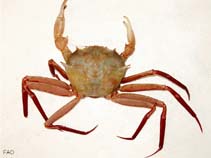
Malacostraca |
Decapoda |
Geryonidae
Environnement : milieu / zone climatique / profondeur / gamme de distribution
Écologie
Benthic; profondeur 5 - 1950 m (Réf. 106297). Subtropical; 46°N - 30°N, 13°W - 36°E
Northeast Atlantic and the Mediterranean Sea.
Longueur à la première maturité / Taille / Poids / Âge
Maturité: Lm ? range ? - ? cm Max length : 6.8 cm CL mâle / non sexé; (Réf. 114235); 2.7 cm CL (female)
Maximum depth from Ref. 122885. Maximum length for females from Ref. 106104. Both max. lengths are based on occurrences (Refs. 106104, 114235); to be replaced with a better reference. Deep-sea species that inhabits bathyal mud bottoms (Ref. 106307). Occurs on the deep middle (Ref. 105217) and lower slope where the species is abundant (Ref. 122885). Recorded in the deep sea along with the gorgonacean coral Isidella elongata (Ref. 122886).
Cycle de vie et comportement reproducteur
Maturité | Reproduction | Frai | Œufs | Fécondité | Larves
Members of the order Decapoda are mostly gonochoric. Mating behavior: Precopulatory courtship ritual is common (through olfactory and tactile cues); usually indirect sperm transfer.
Bisby, F.A., M.A. Ruggiero, K.L. Wilson, M. Cachuela-Palacio, S.W. Kimani, Y.R. Roskov, A. Soulier-Perkins and J. van Hertum 2005 Species 2000 & ITIS Catalogue of Life: 2005 Annual Checklist. CD-ROM; Species 2000: Reading, U.K. (Réf. 19)
Statut dans la liste rouge de l'IUCN
(Réf. 130435: Version 2025-2 (Global))
statut CITES (Réf. 108899)
Not Evaluated
Not Evaluated
Menace pour l'homme
Utilisations par l'homme
Pêcheries: commercial
FAO - Publication: search | FishSource |
Outils
Plus d'informations
Dynamique des populations Cycle de vieReproductionMaturitéFéconditéFraiŒufsDéveloppement de l'œufLarves Liées à l'hommeTimbres, pièces de monnaie, divers
Sources Internet
Estimations basées sur des modèles
Résilience
(Ref. 69278): |
Haut, temps minimum de doublement de population inférieur à 15 mois (K=0.3-0.54) |
Vulnérabilité de la pêche
(Réf. 71543) |
Low to moderate vulnerability (28 of 100). |
Catégorie de prix
(Réf. 80766): |
Very high. |