Malacostraca |
Decapoda |
Parthenopidae
Miljö: miljö / Klimatzon / djupintervall / distributionsområde
Ekologi
Revassocierade; djupintervall 0 - 125 m (Ref. 105618). Tropical; 32°N - 31°S, 30°E - 108°W
Indo-Pacific. Tropical and subtropical.
Längd vid första mognad / Storlek / Vikt / Ålder
Könsmognad: Lm ? range ? - ? cm Max length : 14.0 cm CL hane/ej könsbestämd; (Ref. 128968)
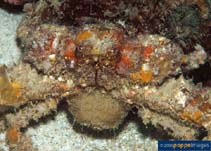
Adults are found under rocks and burried in sandy mud (Ref. 128968). The pentagon-shaped carapace and appendages are covered with spines. Pincers are unequal in size, length of which are double the size of the carapace (Ref. 128968). May contain toxins that are undectectable in tests (Ref. 107779), and thus, may not be safe to eat (Ref. 128968). Prefers sandy substrates (Ref. 2899). Subtidal (Ref. 106854). Large chela is used to crush snails and molluscan shells of hermit crabs. Reported to be mildly toxic to toxic. Toxicity of its flesh may be a result of accumulation of toxins from its diet (Ref. 102986).
Livscykel och parningsbeteende
Könsmognad | Reproduktion | Lek | Ägg | Fekunditet | Larver
Members of the order Decapoda are mostly gonochoric. Mating behavior: Precopulatory courtship ritual is common (through olfactory and tactile cues); usually indirect sperm transfer.
Poupin, J. 2050 Database of Crustacea (Decapoda and Stomatopoda), from Central Pacific Islands (French Polynesia, Pitcairn, Easter Island, Clipperton). Http://decapoda.ecole-navale.fr/index.php and http://decapoda.free.fr. [Accessed 160207]. (Ref. 2891)
Status på IUCN:s rödlista
(Ref. 130435: Version 2025-2 (Global))
CITES-status (Ref. 108899)
Not Evaluated
Not Evaluated
Hot mot människor
Poisonous to eat (Ref. 128968)
Mänskliga användningsområden
Fiskeri: kommersiell
FAO - Publication: search | FishSource | Havet omkring oss
Verktyg
Ytterligare information
LivscykelReproduktionKönsmognadFekunditetLekÄggUtveckling av äggLarver MänniskorelateradFrimärken, mynt, diverse.
Internet-källor
Uppskattningar baserade på modeller
Sårbarhet i fisket
(Ref. 71543) |
Low vulnerability (10 of 100). |
Priskategori
(Ref. 80766): |
Unknown. |
Nutrients
|
Calcium = 109 [35, 184] mg/100g; Iron = 1.59 [1.21, 1.97] mg/100g; Protein = 20.2 [19.2, 21.3] %; Omega3 = 0.285 [0.185, 0.386] g/100g; Selenium = 48.3 [-31.7, 128.3] μg/100g; VitaminA = 0 μg/100g; Zinc = 1.79 [1.17, 2.40] mg/100g (wet weight); based on nutrient studies. |