Malacostraca |
Decapoda |
Parthenopidae
สิ่งแวดล้อม : สิ่งแวดล้อม / เขตภูมิอากาศ / ระดับความลึก / ระยะการกระจายสินค้า
นิเวศวิทยา
เกี่ยวกับหินโสโครก; ระดับความลึก 0 - 125 m (อ้างอิง 105618). Tropical; 32°N - 31°S, 30°E - 108°W
Indo-Pacific. Tropical and subtropical.
ความยาวเมื่อครบกำหนดครั้งแรก / ขนาด / น้ำหนัก / อายุ
วัยเจริญพันธุ์: Lm ? range ? - ? cm Max length : 14.0 cm CL เพศผู้/กระเทย; (อ้างอิง 128968)
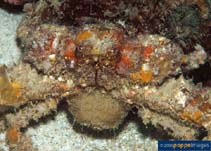
Adults are found under rocks and burried in sandy mud (Ref. 128968). The pentagon-shaped carapace and appendages are covered with spines. Pincers are unequal in size, length of which are double the size of the carapace (Ref. 128968). May contain toxins that are undectectable in tests (Ref. 107779), and thus, may not be safe to eat (Ref. 128968). Prefers sandy substrates (Ref. 2899). Subtidal (Ref. 106854). Large chela is used to crush snails and molluscan shells of hermit crabs. Reported to be mildly toxic to toxic. Toxicity of its flesh may be a result of accumulation of toxins from its diet (Ref. 102986).
วงจรชีวิตและพฤติกรรมการผสมพันธุ์
วัยเจริญพันธุ์ | การสืบพันธุ์ | การวางไข่ | เซลสืบพันธ์ของเพศเมีย(ไข่) | ความดกของไข่ | ตัวอ่อน
Members of the order Decapoda are mostly gonochoric. Mating behavior: Precopulatory courtship ritual is common (through olfactory and tactile cues); usually indirect sperm transfer.
Poupin, J. 2050 Database of Crustacea (Decapoda and Stomatopoda), from Central Pacific Islands (French Polynesia, Pitcairn, Easter Island, Clipperton). Http://decapoda.ecole-navale.fr/index.php and http://decapoda.free.fr. [Accessed 160207]. (อ้างอิง 2891)
สถานะบัญชีแดงของ IUCN
(อ้างอิง 130435: Version 2025-2 (Global))
สถานะไซเตส (อ้างอิง 108899)
Not Evaluated
CMS (อ้างอิง 116361)
Not Evaluated
ภัยคุกคามต่อมนุษย์
Poisonous to eat (อ้างอิง 128968)
การใช้ของมนุษย์
การประมง: การค้า
FAO - Publication: search | FishSource | ทะเลรอบๆเรา
เครื่องมือ
ข้อมูลเพิ่มเติม
พลวัตของประชากรการเจริญเติบโตอายุสูงสุด / ขนาดความยาว-น้ำหนักสัมพันธ์ความยาว-ความยาวสัมพันธ์ความยาว-ความถี่การแปลงมวลอุดมสมบรูณ์ วงจรชีวิตการสืบพันธุ์วัยเจริญพันธุ์ความดกของไข่การวางไข่เซลสืบพันธ์ของเพศเมีย(ไข่)การพัฒนาไข่ตัวอ่อน เกี่ยวข้องกับมนุษย์แสตมป์ เหรียญ อื่นๆ
แหล่งที่มาจากอินเตอร์เน็ต
การประมาณค่าตามแบบจำลอง
ความเสี่ยงต่อการตกปลา
(อ้างอิง 71543) |
Low vulnerability (10 of 100). |
หมวดหมู่ราคา
(อ้างอิง 80766): |
Unknown. |
Nutrients
|
Calcium = 109 [35, 184] mg/100g; Iron = 1.59 [1.21, 1.97] mg/100g; Protein = 20.2 [19.2, 21.3] %; Omega3 = 0.285 [0.185, 0.386] g/100g; Selenium = 48.3 [-31.7, 128.3] μg/100g; VitaminA = 0 μg/100g; Zinc = 1.79 [1.17, 2.40] mg/100g (wet weight); based on nutrient studies. |