Gastropoda |
Not assigned |
Lottiidae
Umwelt: Milieu / Klimazone / Tiefenbereich / Verbreitungsgebiet
Ökologie
Benthic. Subtropical
Pacific Ocean: Alaska to Mexico. Boreal to tropical.
Länge bei der ersten Reifung / Größe / Gewicht / Alter
Geschlechtsreife: Lm ? range ? - ? cm Max length : 5.4 cm SHL Männchen/unbestimmt; (Ref. 95344); common length : 4.0 cm SHL Männchen/unbestimmt; (Ref. 312)
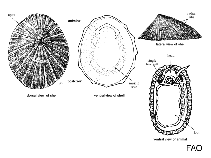
Apex near center, irregular ribbed slopes. Some possess a brown colored shell with alternating brown and white checks at the edge. Other colorations of this limpet exist and can be found in the same area. Both the substrate the limpet lives and its diet determine the color of its shell (Ref. 312).
It has a shell length of 4 cm (Ref. 312). Maximum shell height at 1.5 cm (Ref. 95344). Occurs in the middle to high intertidal zone (Ref. 312); common from the low to mid-intertidal; the largest individuals are found lower on the shore farthest from effect of wave action (Ref. 310). Non-selective herbivores, consuming a wide variety of algae (Ref. 312). Commonly found in mussel beds and associated with brown algae (e.g., the sea palm, Postelsia)
Lebenszyklus und Paarungsverhalten
Geschlechtsreife | Fortpflanzung | Ablaichen | Eier | Fruchtbarkeit | Larven
Members of the order Patellogastropoda are mostly gonochoric and broadcast spawners. Life cycle: Embryos develop into planktonic trocophore larvae and later into juvenile veligers before becoming fully grown adults.
Gallivan, G. and J. Danforth 1999 Phylum Mollusca. Marine Science Institute. (Ref. 312)
IUCN Rote Liste Status
(Ref. 130435: Version 2025-2 (Global))
CITES Status (Ref. 108899)
Not Evaluated
Not Evaluated
Bedrohung für Menschen
Nutzung durch Menschen
FAO - Publication: search | FishSource |
Tools
Mehr Information
Trophische ÖkologieLebensmittel (Beutetiere)
Nahrungszusammensetzung
Nahrungsaufnahme
Räuber
PopulationsdynamikWachstum
Max. Alter/Größen
Länge-Gewicht-Rel.
Länge-Länge-Verhältnis.
Längenhäufigkeiten
Massenkonvertierung
Dichte
LebenszyklusFortpflanzungGeschlechtsreifeFruchtbarkeitAblaichenEierEientwicklungLarven PhysiologieSauerstoffverbrauch
MenschenbezogenBriefmarken, Münzen, Verschiedenes.
Internet Quellen
Schätzungen auf der Grundlage von Modellen
Anfälligkeit der Fischerei
(Ref. 71543) |
Low vulnerability (10 of 100). |
Preiskategorie
(Ref. 80766): |
Unknown. |